Why Antietam Wasn't Enough to Save McClellan
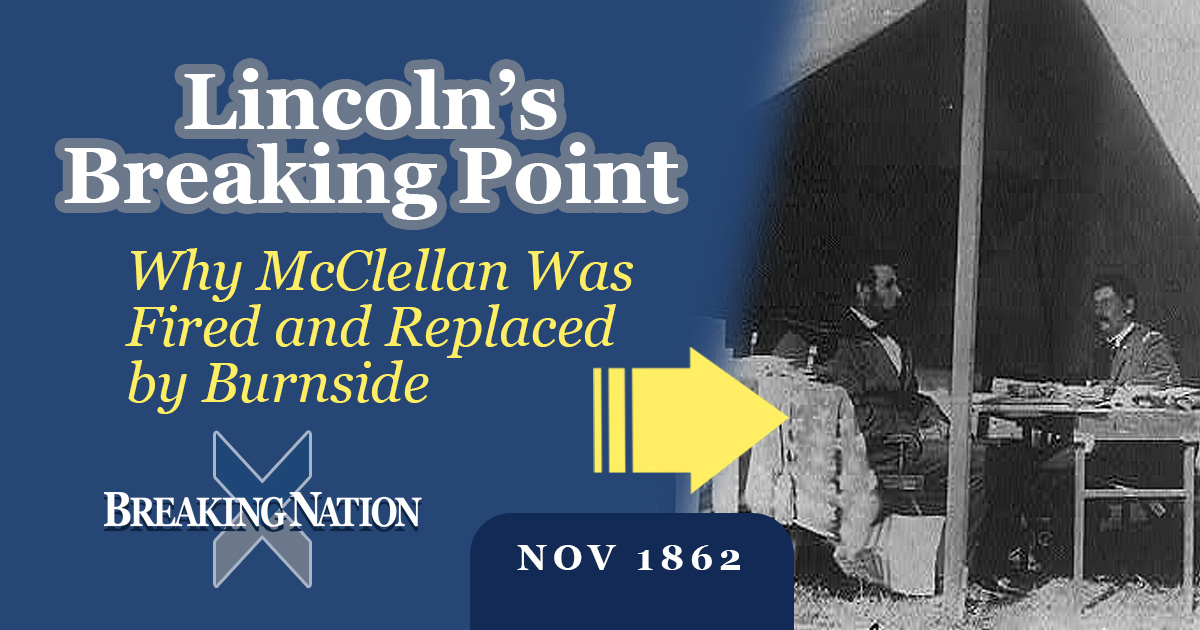
On November 7, 1862, President Abraham Lincoln removed Major General George B. McClellan from command of the Army of the Potomac and replaced him with Major General Ambrose Burnside. The decision came less than two months after the Battle of Antietam, where McClellan had halted Robert E. Lee's invasion of Maryland but failed to deliver the decisive victory Lincoln desperately wanted. For the president, the question was no longer whether McClellan could organize and command a formidable army. It was whether he could bring that army to bear against the Confederacy with the urgency the war demanded.
McClellan's accomplishments were considerable. After the Union defeat at First Bull Run in July 1861, he transformed a disorganized collection of volunteers into a disciplined fighting force. His soldiers admired him, affectionately calling him “Little Mac,” and his organizational talents were undeniable. But his reluctance to act consistently frustrated Lincoln. McClellan habitually overestimated Confederate strength, requested additional reinforcements, and hesitated to exploit opportunities. After Antietam, Lee's army escaped across the Potomac, and McClellan's failure to pursue aggressively became the final straw. Lincoln had given his general another opportunity to demonstrate that he could turn a defensive success into a strategic victory. Instead, patience in Washington ran out.
The search for a replacement was not straightforward. Lincoln had previously offered Burnside the command twice, and Burnside had declined, believing himself unqualified to lead so large an army. His record nevertheless offered some reassurance: he had won victories in North Carolina and commanded a substantial portion of the Army of the Potomac during the Maryland Campaign. He was also McClellan's senior subordinate, making him a logical choice within the existing command structure. This time, Lincoln insisted, and Burnside accepted.
Joseph Hooker was another possible contender. An aggressive and capable battlefield commander, Hooker had earned a reputation for fighting hard and had supporters who believed he deserved greater responsibility. Yet he was also outspoken, politically connected, and known for criticizing fellow officers. Burnside reportedly feared that refusing the appointment again would leave the command to Hooker, whom he considered less suitable. Lincoln ultimately selected Burnside rather than elevate Hooker at that moment. General-in-Chief Henry Halleck was not a serious alternative; Lincoln regarded him as more useful in his existing advisory role than as a field commander.
The political circumstances mattered, too. The Republican losses in the November 4 midterm elections demonstrated growing Northern frustration with the war, while Lincoln's preliminary Emancipation Proclamation had raised the stakes of military success. The president needed an army that could translate its numerical and material advantages into meaningful results. McClellan's caution had become more than a military frustration; it threatened to undermine confidence in the administration's conduct of the war.
Lincoln issued the formal order on November 5, with the change taking effect over the following days. In removing McClellan, he demonstrated that personal popularity and organizational brilliance could not indefinitely compensate for a perceived unwillingness to act. The decision marked another step in Lincoln's evolution from a president who deferred heavily to professional military judgment toward one increasingly determined to hold his generals accountable to the war's larger strategic and political purposes.
Breaking Nation: A Civil War Podcast explores the American Civil War, its turning points, and our national memory. Discover full episodes, transcripts, and resources at www.breakingnation.com — your destination for in-depth Civil War podcast content and fresh perspectives on America’s past. Listen on Apple Podcasts, Spotify and Amazon Music.
The North Turns on Lincoln: The Midterm Elections of 1862