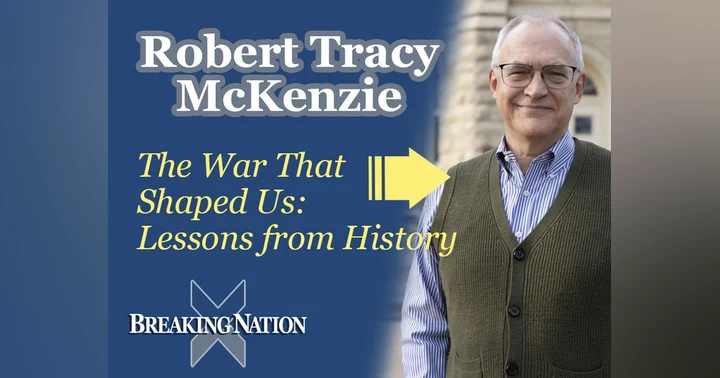
Interview with Robert Tracy McKenzie


In this conversation, historian Robert Tracy McKenzie reflects on a career spent studying and teaching America’s past, from the Civil War to the broader story of democracy. He shares how his upbringing in Tennessee and the influence of family and mentors shaped his calling as a historian. McKenzie discusses the challenges of writing about divided communities like Knoxville during the Civil War, the importance of resisting presentism, and the misconceptions many Americans still hold about that conflict. Throughout, he emphasizes how history, rightly approached, is less about collecting facts than about cultivating wisdom for the present.
Check out our website at http://www.breakingnation.com
Breaking Nation: A Civil War Podcast is a production of Waveland Creative.
Host: Scott Holmgren
Robert Tracy Mackenzie has spent nearly four decades as a historian, teacher, and author exploring America's past, from divided Civil War towns to the fragile roots of democracy itself. In this conversation, he reflects on history's power to shape wisdom for today. But what happens when a nation forgets or misremembers its past? Welcome to Breaking Nation, a Civil War podcast. I'm your host, Scott Holmgren. My goal is simple: to bring the American Civil War to life by exploring and discovering the people, the places, and the events of this critical era, as if we didn't know how it would turn out. I am so excited about this special episode to have historian and author Tracy McKenzie on the podcast to discuss the relevance of the Civil War today and the case for historical literacy. Thank you very much for being here today. Scott, it's my pleasure.
SPEAKER_00I'm looking forward to our conversation.
SPEAKER_01I'd like to first find out about your background and how you embrace the disciplines and calling of being an historian. And then let's look at history in general and the Civil War in particular. Sound good?
SPEAKER_00Sounds good.
SPEAKER_01Excellent. All right. So when did you know you were into history or or first wanted to study and write about it?
SPEAKER_00Well, I think I was interested in history from a very early age. Um, it was just always a subject that I very much uh enjoyed. I had a sense my my father was uh on a destroyer in the Second World War, my grandfather was uh in the United States Army during World War I. Uh they loved to share their stories. And so I think I was interested in history from very early age. Uh when I started college, um it was a time when you were still required to study some history, it was a general education requirement, so I loved that. And I had a professor that uh convinced me that um I could major in history without knowing that I wanted to be an academic historian, which I think was wonderful advice. I'm so thankful that he uh shared that with me. So I decided to major in what I really enjoyed and worry about the details uh over time. Uh and I think it was really uh probably at the end of my first semester of graduate school that I thought, hey, I I really, I really am excited about an academic path. I was able to go to graduate school on a uh fellowship. It wasn't going to cost me any money. And so I think I started saying, I'm just gonna we'll we'll see what this is like and see um uh if this is a good fit or not. Uh but I remember returning after my Christmas break, my first Christmas break, returning to graduate school, and realizing I was just absolutely loving this. Uh and so I feel pretty affirmed by that ever after. And so I'm finishing up, or actually, I'm beginning now my 38th year as a professor. Uh, and hopefully we'll add a few more. And I'm just so thankful I wouldn't trade it for anything.
SPEAKER_01Was there anything about your schooling or about that experience that really stands out? Was there one thing or or maybe a professor, something that really, really affirmed for you, like you said, particularly?
SPEAKER_00Well, I I still I would I would say the professor that had the greatest impact was still that professor um early in my undergraduate career who um took an interest in me. I had classes uh with him as a freshman. Uh he um told me he wanted to talk with me about my future. He said, you know, if you don't know um what you want to major in by the time you're in your toward the end of your sophomore year, he says, come see me and let me make an argument for why history is a good fit. And and that really was a life-changing uh experience. I didn't know it at the time, but looking back on it, it really was one of those uh crossroads that made a uh a major uh impression. And then when I got to to um to graduate school, it was just it was exhilarating. And that sounds sort of corny to say, hook, it's exhilarating, but it was. I was surrounded, it was a small cohort, um uh probably eight or ten incoming students uh in that graduate class at Vanderbilt, and they were all uh, you know, all in in their studies. They were fascinated, they were excited to be there. We had wonderful conversations. Um, the graduate students uh had offices in a in an old house that had been acquired by the uh university for TAs. And we would sit out on the front porch and and argue in the afternoons about the latest historical debates. Uh, and um, you know, there was just no price I could put on that. It was just really uh um it was it was inspiring and nourishing and uh and fun.
SPEAKER_01So uh obviously everybody's roots impacts and influences sort of the direction in life, and certainly uh going to school in Tennessee and and and later writing about that. What part does your history and your roots play into then that passion that you carried forward?
SPEAKER_00Well, I've mentioned already, you know, my my father and grandfather and their particular, you know, small roles and major historical um uh events in American history. I think um growing up in Tennessee did have a major impact on me. Um, I don't know when I first discovered the American Civil War, but I know that by the time I was maybe in second grade, my mother recorded in a little book she was keeping about me that my my favorite song was the battle hymn of the republic. Probably wasn't true of too many seven-year-olds, uh, I guess at the time. Uh, but as I as I learned about the fact that there was a civil war, I I watched uh so none of this is intellectual, uh, Wonderful World of Disney on Sunday evening. And uh they showed this uh TV movie uh on the little drummer boy of Shiloh. Uh and all of a sudden I'm seeing this uh child about my age engaged in this incredibly exciting adventure in my part of the world, and it became um became concrete uh in a way that that it might not have otherwise. And then in conversations with my grandfather, who I saw very regularly, lived in our same town, uh he was born in 1890, and I learned that his father was born in 1860. So his father, his father had lived, it was young, but he had lived through the Civil War. Uh and the fact that I could be only, you know, two or three generations removed from from someone who had experienced that, uh, just magnified that sort of sense of personal connection. So I have no doubt that um that my particular uh geographical origin and roots is also part of the story of why I became interested in the Civil War.
SPEAKER_01Is there a book that you can recall? Is there a title you remember thumbing through or checking out of the library repeatedly? Is there some book that that comes to mind uh in those early days when you when you knew you were loving history and enjoying it?
SPEAKER_00Yeah, so I yeah, that's a good question. And I'm not gonna be able to answer that question precisely. There was a uh actually a children's book series that I uh encountered in the public library when I was in elementary school, and it uh it followed two cousins from Kentucky. And uh the premise was that one became a union soldier, and one became a Confederate soldier. And the the novels, there were many in the series, would focus on a particular battle, and they would either center on the Union or the Confederate um uh cousin. Uh, and I loved those. Uh by the time I got to high school, I was reading Bruce Catton, uh, who is not trained as an academic historian, who's a journalist by his trade, but a wonderful writer. Uh, and so I had read his um trilogy of the American Civil War and his trilogy of the Army of the Potomac uh by the time I'd finished high school. So those were certainly feeding my um my kind of interest in the in the Civil War.
SPEAKER_01Yeah, I think Bruce Canton appears on almost everybody's list at some point, right? Um, let's talk about you then as a writer in terms of uh the books you've authored and talk about your habit. So when you sit down to write, uh what is your habit? Uh how do you do outlining? Uh, how do you set goals for uh research and writing? Give us a glimpse behind the curtain there on your process.
SPEAKER_00Uh great question. The first thing that comes to my mind, though, Scott, is that none of your listeners should look to me for an example, uh, because I don't um I really don't think I have a very good um uh approach or good sets of habits or anything like that. Uh writing is hard for me. Uh and so when you say, what do you do when you sit down to write? My first thought is, well, I stare at the screen for about half an hour. Uh and so it is it is hard. And and I think um sort of a particular hang up of my own is I think I'm a perfectionist. I agonize over not just individual paragraphs, but individual sentences. Uh, and um that really slows the process down for me. I also would say that I write to work out what I think about something. So I don't have a finished argument in my mind when I sit down to write about a particular topic. I am wrestling with the topic in the process of trying to craft uh an argument that I think is persuasive, that I think um makes allowances for the complexity of whatever the topic is. So in the books that I've written, I've tended to begin really not with a clear outline, as much as just with a single idea that I want to drive uh the book ultimately. Uh so um the book that I have finished most recently, um, We the Fallen People, the the thing that really struck me, it had grown out of my teaching over the years on American history, American democracy specifically, uh, was that Americans' understanding of human nature had changed dramatically, and the way that that informs our politics uh has uh changed dramatically. Uh, and I wanted to illustrate that historically, because I think that's a really good way to see things uh in a new light. And so starting with that idea, I began to sort of figure out how to approach that. But I would be absolutely deceiving you to say that I had a clear sense of what that was going to be on the front end. And it goes through many drafts, many, many iterations. For me, the most important thing is just to keep moving forward. Uh, and so I try to write in the mornings, try to uh have my courses scheduled so that I can do that pretty regularly. And if I can write 300 words uh in a day and and just do that pretty regularly, that adds up over time. Uh and um and I'm I'll feel um satisfied by that.
SPEAKER_01So uh as a writer myself, uh there's this thing, writer's block, whether you believe it or not. So so the question is yes, when you have that moment, you're staring at the screen for about 30 seconds or longer. Uh, what have you found to be effective? Is there is there something that you you have found to be conducive to getting the creative juices flowing, or maybe there's music or an activity or something that that sort of primes the pump?
SPEAKER_00Uh right. So um, yeah, no, no, I wish there were. I wish there was some clear um uh habit or practice that seemed to break that uh logjam. I tend to write in public, so I write in coffee shops a great deal. Uh I can't listen, I can't hear anything um in terms of other tables or whatever, because I'm immediately drawn into those conversations. So I I try to drown that out with music. But what I do when the weather allows, I I think of my own writing as an extension of my teaching. Uh, and so as I'm writing, almost whether it's conscious or unconsciously, uh, I really am imagining um a kind of classroom context. Uh, and so one of the things that I have found sometimes helpful, I love to walk and I'll go to a nearby nature preserve and I'll get out the uh voice recorder on my phone and I will lecture. I'll know where I am in my writing, I know what the next couple of paragraphs I hope will focus on. And I just um try not to have a script in mind. I'm just telling myself, how would I discuss this in an engaging way with a small group that I can visualize? And I record myself. Uh, and and I I think that sometimes, maybe, uh, that leads to a more conversational and a less maybe less stilted, a little less professional kind of uh prose. And then I'll go to the coffee shop and I'll I'll basically listen to my own dictation and transcribe it.
SPEAKER_01Wow, that's an awesome technique. Uh over the years as you've written, what have you learned most about yourself through that process?
SPEAKER_00Oh, then I'm obsessive compulsive. Uh I I think writing is a wonderful discipline for me. It's not something I I don't ever I I rarely, I should say, feel like there's um a flow that's just coming naturally. Uh it's it's forcing myself to be as precise in my reasoning uh as I can, hopefully in a way that is um persuasive to someone else. Uh and so I I think of it's it's almost like a uh a discipline, you know, uh eating your vegetables. It's not really all that enjoyable, but uh, but I think it has I think it has positive benefits.
SPEAKER_01Yeah, yeah. Is there uh is there any projects you have currently in the works, anything that you're working on right now?
SPEAKER_00Uh yes, and um and I wish it were going faster uh than it is, but yes, I'm I'm um knee deep into a project uh that I believe is going to become a book. Uh and I hope I'll have a finished manuscript within uh certainly another year, hopefully a little less than that. Uh the title, at least tentatively right now, is The Almighty Has His Own Purposes. Uh that's a direct quote from uh Lincoln's second inaugural address. Uh it's a um uh a study, really, of Lincoln's two most famous speeches, the Gaysburg Address and the Second Inaugural. Uh, and I'm trying to uh put them as concretely as I can uh into their historical contexts uh with an eye to thinking about what scholars call uh American civil religion. Uh, the the way that we, not in a formal religious institutional context, but just in the public square, talk about the values that we think are worth fighting for, even maybe dying for, and where they come from. Uh, and so I'm trying to read those two speeches as two really profound but very different um observations uh on that in that area.
SPEAKER_01Wow. Wow, well, I will be one for sure looking forward to that one. Um let's shift gears a little bit. Thank you for unpacking a lot of that. That's fascinating. Uh, I'd like to talk a little bit about your book, Lincolnites and Rebels, A Divided Town in the American Civil War, that looks at the city of Knoxville, Tennessee during the war. And uh in the preface, I think you describe seeing a drawing from the period. And um, it's interesting because I know that picture. I know I've seen it like in the American Heritage book. They had a picture of it in there, so I can visualize it. Uh, and and in your book, you write, quote, one small town street, simultaneous Union and Confederate rallies. I couldn't forget this image, nor could I shake the questions that it raised. Historians often use pictures to illustrate their books. I began this book because I wanted to understand a picture. End quote. What did you discover as you explored and told that story of Knoxville in the Civil War?
SPEAKER_00So, oh thank thank you for asking that, uh, Scott. Um just a word maybe of of context before I dive into an answer um about Knoxville itself. And some of your listeners may know this, but not all. Um on the eve of the Civil War, we're Knoxville is a it's a pretty small town, somewhere between three and four thousand its population. Uh and yet um it's actually the largest town in that area of southern Appalachia. Uh people in Knoxville boosters were uh want to call themselves the metropolis of East Tennessee, which sounds a little overblown, and it is. Uh, and yet, uh, if you if you drew a circle with Knoxville at the center and had a radius of 150 miles in every direction, so going down into northeast Georgia, western North Carolina, southwestern Virginia, southeastern Kentucky, uh, Knoxville's the biggest city in an area of 70,000 square miles. Uh, it's also strategically very important. It's set astride the major railroad line from Georgia to uh Virginia. Uh and because of its importance, because there's not a lot of uh other alternatives, it becomes the administrative center uh militarily uh throughout the war. Uh and so it is occupied by one army or the other for all but three days of the war. It's also almost perfectly evenly split between Unionist and Confederates. Uh and you know, for all the um emphasis that we put on a brother's war or a neighbor's war, internal uh conflict, it's rare for a community itself, a pretty small community, so be so bitterly internally divided. The bigger pattern we see is pockets here and pockets there of Union or Confederate sentiment, not a single community so bitterly divided. So I was fascinated uh with that. Uh, and then this picture that you refer to, uh, which was done by someone who was on the ground during the war, uh, drawing this from memory, uh, recreated what I just thought was uh an event that encapsulated Knoxville Civil War, the simultaneous uh rallies on two ends of the same street uh simultaneously. So I wanted to say, okay, in such a situation as this, how do neighbors become enemies? What does it mean to them personally uh that that person now is my enemy? Um how does the war, if it does, change uh their allegiances over time? And so some of the things I discovered. Uh the first thing I think that surprised me was that there was more common ground between the Unionists and Confederates than I was expecting. In fact, a lot of common ground. Uh, neither of those groups is advocating the right of secession. Tennessee is a little bit different uh from the other states that ultimately join the Confederacy. It does not pass an ordinance of secession, it uh passes a declaration of independence. Uh and so that sort of is framed how the conversation takes place in Knoxville. No one is asserting that there's a constitutional right to secede at will. They're saying, though, that going back to the uh rights enshrined in the Declaration of Independence, that when the government becomes abusive of those rights, then is the right of the people to alter or abolish the form of government. So the question becomes uh if we agree that there is a right of revolution, is it justified in this instance? And so they're not debating over whether there's a right of revolution, they're not debating over whether there is a constitutional right of secession. They're really discussing the pragmatic argument for whether now is the right time, whether these are the circumstances that would justify this. Uh, everyone, Unionist Confederates alike, are staunchly defending slavery. All right. And so we slavery, of course, looms so large as the war unfolds. And we would expect Unionist Confederates to take some clear, different position on that, but they they do not. Uh William Brownlow, who's a very prominent unionist leader in Knoxville, newspaper editor, uh, he writes early on in the secession crisis is that uh he says, if you could convince us uh that Lincoln was prepared to invade the South and free the slaves, there would not be a unionist in Knoxville in 24 hours. Uh, and so the debate over this now is where is slavery most secure? Uh is slavery safest within the union under the Constitution? Uh are we better off? Is it more secure if we uh separate ourselves? Uh so both sides are pro-slavery. Neither side is advocating the right of secession. Um neither side is really committed to the union. Uh, and this is the one that probably is the most surprising. Uh, Knoxville Unionists, many of them become actually fairly famous, at least for a time, in the North during the war. And East Tennessee itself becomes sort of this symbol to Abraham Lincoln, to other uh northerners, of uh true Southern loyalty. Uh they're the exception to the rule, but they're there. Uh, Lincoln really wants to see the military, if possible, quote, liberate East Tennessee uh from Confederate rule. And certainly there are uh individuals like Brownlow. Individuals like Horace Maynard, who serves in the United States Congress, even while Tennessee is uh not in the uh the Union, they're giving speeches talking about this just undying devotion that these Southern mountaineers have to the Union, that it is a religious conviction with them. It is paramount, it supersedes all other loyalties. None of them are saying that during the secession crisis at all. Uh they're not saying we are unconditionally committed to the Union. Uh, they're saying we would probably support uh the Confederacy if we knew that slavery was uh at risk. They're often justifying their opposition to secession uh for very different kinds of reasons. I think a lot of the Knoxville Unionists just hate the fact that the leading supporters of secession are Democrats. Uh, and a lot of these unionists in Knoxville have been Whigs before the war. Uh so a lot of it has to do with partisan loyalties, some of it has to do with where you went to church, some of it has to do with other sorts of uh things. But there's there's basically no unconditional unionism. Uh historians, it's since I wrote the book, but historians have now come to call um Southern Unionists, often call them anti-Confederates, which is a very different connotation than the term unionist. Uh, it says that what is propelling my opposition to the Confederacy has more to do with my negative commitments than it has to do with a positive commitment to the Union. And I think that's absolutely true with regard to uh to Knoxville. So it's a less kind of glorious story. Uh it's a messier story. Uh I write in the book that not only do we think of uh a snapshot in time, so we look at what divides Unionists and Confederates when the uh die is being cast, but there's also the sense that once a war begins, it has its own dynamic. And as I like to tell my students, war changes things. Uh and the positions that people take when the war begins may not be at all like the positions they ultimately settle on over time. And that's true, uh, I think with Knoxville's story. And the best example of this uh is that those uh local unionists who said uh in the spring of 1861, if you told me that the uh union was going to destroy slavery, I'm out of here in an instant. Give it a year and a half, uh, and there are there are actually many of them, not all, but many of them will ultimately uh come over to the side of supporting emancipation. And they will support emancipation largely, I think, within that dynamic of opposition of the last year and a half, military occupation by an enemy, various kinds of injustices that they perceive. And they're going to embrace emancipation as a war measure, as an act of revenge. Uh, and and so you'll have people who have built their entire careers on uh defending slavery, ultimately endorsing the Emancipation Proclamation.
SPEAKER_01Wow. Wow, yeah. Um how is the Civil War, given given that, and given the fact that there's the reality of those divides that exist even in society today, at different levels around different issues, obviously. But how is the Civil War still relevant history then for Americans? I mean, it seems like in the past year, what the word civil war has has been used more often than I can remember, right outside of historical and reenactment events. But but this idea of the division that so deeply divides is finding new ground. And so how would you say that that is relevant to America today?
SPEAKER_00It's a great question, Scott. And let me just start by just um affirming what you have said about the prevalence of references to Civil War. Uh, I haven't done any systematic study, but I'm absolutely uh convinced as you are that it had popped up into popular usage uh in a way that I can't recall uh in my adult life. Uh and uh in fact, I start my course now on the American Civil War with screen takes from magazine covers and newspaper editorials and all the different references to Civil War uh that have been so common in the last few years. Why is the Civil War still relevant? It used to be that you had answered that question. Uh, James McPherson, a very prominent uh story in Civil War for uh several decades, once called the Civil War the war that never goes away. And his idea was just sort of perpetually relevant in some way. But I think McPherson would have said, and I would have said 10 years ago, uh, that it's most relevant simply in that it was a defining moment when the nation is becoming a nation. Uh it's defining of American identity, or at least the way we want to understand ourselves, uh, and that you just can't understand what it means to be um uh an American if you don't have some familiarity with civil war.
SPEAKER_01I often think of it, I often think of it as America's adolescence, right? Trying to find that identity. There you go.
SPEAKER_00Okay. We're we're trying to figure out who we are, who am I? Uh I would go farther today, uh, and this this sounds more ominous, and I don't mean for it to necessarily, but I think a reason why the civil war is relevant today is that we uh should very desperately not want to repeat it. Uh I I don't think the you know the there's any kind of clean analogy between the Civil War of 1861 and 65 and anything that's happening today. And yet, on one level, I think we should want to uh embrace to engage to try to understand the Civil War, because if nothing else, it shows us that citizens of the United States who were no less intelligent and no more uh self-interested or evil than we are made catastrophic miscalculations uh and followed a path that ultimately led to a unfathomable tragedy. Uh, and the worst possible uh thing that we might take from that is that it couldn't happen again. And and I'm not predicting anything, I'm just saying that I think to say that it couldn't happen again is the ultimate expression of arrogance. Uh, and so figuring out why it happens uh more than a century and a half ago might help us uh in thinking about where some of the points of vulnerability uh are today. The the one thing that immediately comes to mind, I I talked to my students about the Civil War as, among other things, absolutely a crisis of confidence in American institutions. It's other, it's more than that, but it is that, certainly. Uh, and so um, you know, anyone who follows the survey data knows that American confidence in institutions has just been going down, down, down, down, down, at least since the 1960s. Uh, and so we have to know that the situation that we face today, where Americans say they don't trust communists, they don't trust the president, they don't trust the Supreme Court, they don't trust the police, um, we trust the military a little bit more, but um generally we don't have much confidence. That is a huge red flag uh for anyone who has studied their history. It should just leap out at us as something that just demands our attention. Uh and um I think you can add to that list. But um, I just I I think the civil war is more relevant than ever in a particular moment.
SPEAKER_01Yeah, well, your comments get at that foundation of what history actually is, right? So so let me uh allow me to read another quote here. You wrote, quote, we live in a time and place in which thinking deeply about the past is a counter-cultural and even radical act. Ours is a present-tense society. We revel in the here and now as indifferent to the past as we are ignorant of it. End quote. And that's from the first Thanksgiving.
SPEAKER_00So, what are your thoughts on how our culture thinks about history so uh first, yeah, first thing I would say, Scott, is um there's nothing new about the sort of uh characterization that you read uh that um uh sort of encapsulates what I think. Um I I don't think when I say we live in a time and place, I I really sort of mean the United States any time in our history. Um uh I'm I suspect to some degree we have always been a present in society. I think I I tend to think that most Americans fall into one of three categories, and this is this is totally broad, you know, painting with a very broad brush, but a lot of Americans just don't care. It it's fundamentally irrelevant to their lives. They cannot see that there's any anything to gain from historical knowledge or any cost historical ignorance. Um, I I think there's another group that finds the past intriguing, possibly entertaining. Uh, you know, we all like a good, I suppose, historical drama. Uh uh we're fascinated by Nazis and World War II, and uh and there's nothing wrong with that. But I'm talking about studying the past just because if it's sort of intrinsically uh interesting to us. It's different and quaint. Um very few Americans that that I'm aware of, and there are some, but very few proportionally believe that the past can enrich our lives in deep ways that possibly enhance our wisdom uh and help to contribute to a better, more flourishing society. Uh, and I think there's a lot of reasons why that's true. I don't think it's some conspiracy. I I think um uh some of some of it's mundane reasons. I think mobility, honestly, we're such a mobile society. Uh, we're cut off from our personal histories. Uh, my father-in-law uh has retired now, just a couple miles from where he was born. He didn't live all his life there, but he moved back there. And he can take you now to uh driving around and show you where his friends from high school lived or where he went to church when he was young and so forth. Uh, most of us don't have those reminders of our past. Uh we live in a, this is a truism to say we live in a society where technological change is just constant. And that, I think, sort of um conditions us to think that everything that is new is improved, everything that is from the past is inferior. Uh, and when we extrapolate that to other things, we just say, what possibly can we learn uh from the past? Uh, Americans themselves, you know, the the motto of the new United States in 1787 is order ordonovo succlorum out of a new order for the ages. Uh the generation, revolutionary generation says we are we are cutting off our ties with our uh origins. We're creating something new, novel uh in world history. And that doesn't lead to a lot of um you know concern for the for the past. And even a democratic society, lowercase d, when Alexis Tocqueville came to the United States in uh the 1830s, he was struck by the difference that in France you can name your ancestors back many, many generations. The United States they didn't know their grandparents. Uh, and so he said one of the aspects of a democratic society is that it will more and more elevate the individual to the building block of the society, not a group, but the individual. Uh, and if we are sort of autonomous individuals, we tend not to think of ourselves as the product of those who have gone before us. So all of these things add up to a fundamentally ahistorical society, and lots of exceptions, but I think as a rule, that's who we are. Uh and um I'm preaching to the choir and saying that to you, I know, uh Scott, but I I think we would agree it it it's not without cost. It's not without cost when we uh are so cut off from our past.
SPEAKER_01Yeah, yeah. Well, along those lines, through your writing, you introduced me to Sam Weinberg and his work on presentism, uh, the idea that we default to looking at the past through the lens of the present. Do you have any thoughts on how we as a culture might be able to work to overcome that presentism?
SPEAKER_00Uh yeah, that's a that's a good question. I don't have a really good answer. For my students, it's something that we work on very intentionally. And if if a student comes to Wheaton and majors in history, we're going to be working on it for several years. Um one of, first of all, I'm so glad that that you gave uh Sam Weinberg a shout-out. He really is um a wonderful resource, a deep thinker. He's done more, I think, to help historians think systematically about what it is that we do than anyone I know of. And one of the things that Weinberg will say is that presentism, this idea of understanding the past through the lens of our current day values. Presentism is not a bad habit we've fallen into, he says. It is our default, it is our natural way of engaging uh with the past. So it never just happens that we fall out of that habit. It really requires a lot of intentionality. Uh, and and what we can do as a society, I don't know. I think um possibly being aware that this is a uh a problem uh is is a first step. It's like um uh Lucy says to Charlie Brown, you know, admit that you have a problem. Uh what Weinberg tells us is that because of this presentism, we're always looking at the past and we're actually sort of seeing a reflection of ourselves, which means that we never really engage with a different way of thinking, which means when you boil it down, we never really learn anything. We may have, it's we're not always wrong, but if we're those areas we're correct, it's because um we were correct already. We're never going to encounter a past that challenges us to rethink something and perhaps to think about it uh more accurately. Um, and so I'm I I'm at a loss about any easy corrections uh to that. Uh, but I think being aware of it, I guess, is is something. It's a step in the right direction.
SPEAKER_01Yeah. Well, you also wrote this in the first Thanksgiving. You wrote, quote, our historical pursuits should seek meaning as well as understanding, wisdom as well as knowledge. They should center on two pivotal questions. What can I learn about the past, and what can I learn about how to live? So, what are the consequences when history is no longer learned from?
SPEAKER_00Yeah. So a little context about that quote, and I appreciate you you sharing it. Um in the context, I was really trying to uh push back against what I think is the dominant uh position that academic historians have taken in the United States really since the late 19th century, which is that um any kind of evaluation of whether a particular belief or action or decision was wise or unwise, moral or immoral, to be admired or not, um is on the face of it unalterably subjective and not really appropriate for uh uh serious scholars. So when it comes to the particular book that you referred to, I was looking at how Americans remember uh their past and the first Thanksgiving specifically, uh the idea would be that I could make some factual observations about what seems to be uh accurate, what's inaccurate, but never speak about how this insight could actually inform how I live. That there might be something there for me to take away that would um possibly change my life. Uh I actually think that's what we always need to be doing, and that won't surprise you, I suppose, by now to hear me say that. For a society that sort of sneers at that uh or turns up its nose or just says this is not appropriate, I think there are all kinds of uh of costs. Um one of the ways I would put it is that I think without the past, we really cannot see ourselves. Uh what the past at its best offers, figuratively speaking, is a place to stand outside of ourselves. We we empathize with folks who live maybe in another part of the world or a very different time in the past. We try to see the world as they saw it, at least for the moment, and from their perspective, look back on our 21st century culture. One of the ways that some historians put this, and I appreciate how they put it, is that we might look to the past and have have it have the effect of making the present seem strange to us. And by that I don't necessarily mean that we have to conclude that it's bad, but simply that it's not obvious, that it's not like gravity, it's not like the air that we breathe, that it's something that requires our attention and our evaluation. Uh, so much of life, I like to tell my students, so much of life is inertia. So much of life is just values that we have absorbed, we've inherited, we've rarely thought about. And when we don't look at the past with any hope of learning something, I think that general trend just continues unchallenged. But I think at its best, um, when we're open to life-changing uh encounters with the past, uh, it can really give us a new perspective for thinking deeply about who we are, what we value, how we want to live in the world, relate to those around us, the kind of society that we aspire to have, and so on.
SPEAKER_01Yeah, well, let's let's kind of take that same idea and flip it a little bit, and let's talk about some of the pushback against that, right? Because you also wrote this. Let me quote again. Um, this is from We the Fallen People, you wrote. Quote, Americans have long found it difficult to think about the nation's founders with discernment. We issue nuance and complexity for an all-or-nothing dogmatism that either venerates the founders or views them with disdain. Let's strive to do better. End quote. So, what problems arrive when history is addressed with arrogance, when there's sort of this looking down one's nose at it? What what do we see come of that?
SPEAKER_00So, you know, the quote that you shared is sort of, I hope, identifying that there are ditches on on both sides of the road. There's the sort of unthinking veneration of uh heroes in the past, where we are either blind to or just resistant to acknowledging any kinds of imperfections and get angry uh if someone else does. And there's the ditch on the other side of the road, which where we say uh these individuals were so backward in their thought or so flawed in their values that there's nothing that we can learn from them. And it's in fact insulting if you suggest that we could. Uh and um your question right now is sort of about that, about that ditch, uh, which I do think is a way of responding to the past in uh in arrogance. A classic example in our particular moment uh would have to do with race. Um, so you know, if particularly if you're interested in the American Civil War, you're gonna encounter people, whether they're military or political figures or others who um uh own slaves or have some real close connection to the institution of slavery. And at that point for 21st century uh students of history, you have to figure out what am I gonna do with that? Does that disqualify these individuals from any kind of uh insight that would be of value to me, any insight that I I could morally endorse. Um, or do we just write them off? Uh and and I think the easy thing is to write them off. Uh, and if you're following the news even today, you know, there's there's debates over the Smithsonian, where the Smithsonian institutions are presenting history uh in the best possible way. And I and I think it would be um uh easy to fall into one of those two ditches in that debate. My own thinking about human nature um is that all of this is flawed, are flawed. Uh the Russian uh writer Alexander Solzhenitsyn put it in a way I've always appreciated. Uh it's very memorable, that the line separating good and evil does not run between nations, between states, between classes, between political parties. The line separating good and evil runs right within every human heart. And so when we encounter, you know, uh individuals in the past who clearly uh are accepting or even endorsing a practice that we would find reprehensible, on one level, it ought not to surprise us. Uh, because we're going to find something like that, if Solzanitson is right, in every human heart. Uh, and um, when we find it, that doesn't negate the possibility that there that same person could have actual insights that we need to hear. The way I tend to think of it is, you know, if we think about slavery again, those individuals that deeply defended slavery or just didn't care had blind spots. They're not our blind spots where we wouldn't be aware of them at all. We wouldn't be so exercised. But our blind spots may be different from theirs, which means taking them seriously might help point to some of our own areas of blindness. This is a very wordy answer to a great but but straightforward question that you asked. What do we lose when we approach the past in arrogance? Well, we cut ourselves off from potential benefit. Um, but it's hard. Uh walking between those two ditches is by definition a challenge. What we're really asking ourselves to do is to exercise discernment rather than all or nothing, uh, to believe that uh individuals will be flawed, uh, will have some uh clear uh moral flaws and also the potential really to teach us something. And holding those two together is just not the way we're wired typically.
SPEAKER_01Yeah, well, and and I would also point to the thing that so easily will push us into either or both of those ditches from time to time is culture and and the media, right? The things that where where most of us tend to get our history from is not a book, unfortunately, right? Or from research or from museums. So often with history, people are often most informed by pop culture and movies or television. So going back to the Civil War specifically, uh what misconceptions about the Civil War that people have would you say that need to be addressed?
SPEAKER_00Well, I think, man, I think we do have a lot of misconceptions about the Civil War. And I think it goes back to what we've just been talking about, which is this all or nothing sort of temptation that we tend to tend to face. Um so the the sort of simple interpretations are the ones that we uh gravitate to. I'll just share really quickly one of my favorite quotes. I put it on almost every course syllabus uh when I offer a course, comes from Alex Alexis de Tocqueville, which was this French thinker I mentioned before, comes to the United States in 1831. Tocqueville later writes in his classic Democracy in America, he writes that a false but simple idea will always have more power than a true but complex one. And and that may sound a little bit too cynical, but I I think we are drawn to the false but but but simple. So when it comes to civil war, one of the most obvious, I would say false but simple ways uh that we uh are drawn to is to see it as north versus south. And uh, and of course, in a in a certain big picture sense, that's true. Uh, and yet both sides were deeply internally divided. And until we recognize that, we miss a really, really important dynamic uh of the war. My book on Knoxville was aimed sort of at addressing one of those uh sides, the fact that there was a lot of internal dissent within uh the South. When we turn to the North, uh recognizing that the Democratic Party didn't go away, it didn't close up shop and retire, there's a very active opposition to the Lincoln administration uh during the Civil War. Lots of controversy within the North over emancipation, over civil liberties, over uh recruitment of black soldiers. Uh, until we see that, uh, we're gonna really misunderstand where the nation is and its values at the time uh of the Civil War. So I think that's a uh a very important one. One of the ones that I really try to hammer in my course on the Civil War is just um I want my students to know that one's attitudes about slavery and one's attitudes about racial equality were not one and the same. Uh, when my students encounter individuals who oppose slavery through presentism in their 21st century sensibilities, they think, well, obviously that means this person, in a general sense, believes in racial equality. And we'll never understand the mid-19th century thinking about that until we separate those two issues. Because there are many, many uh individuals who will oppose slavery, even for moral reasons, who don't believe that that in any sense logically obliges them to believe in racial equality. I don't think we can understand the century and a half since the Civil War if we believe that by 1863, a large majority of northerners had suddenly uh embraced racial equality. Uh, because if that were true, then the rest, you know, the rest of the 19th century and 20th century just doesn't make sense. When we disentangle those issues, I think it begins to unlock a much larger swath of American history. So those would be two examples that I think are important.
SPEAKER_01Yeah, yeah. Earlier you mentioned um military history, right? And obviously Knoxville, there was there was fighting there, both sides armies occupied the city. Um, as we wrap up, I'd like to ask a question specifically about that, quoting you again from Lincolnites and Rebels. You say, quote, this reminds us that if the onset of war can reveal a society's most deeply held values, the dynamic of war can also transform them. This is precisely what happened at Knoxville, but only up to a point, end quote. So that military aspect to the war, there certainly is the societal aspect, the political aspect, the economic aspect, the thought, the the justice, right, the lawgiving. But from a military perspective, how does military history have usefulness to everyday Americans if it does?
SPEAKER_00Yeah. So I I would uh preface my answer to that really important question uh by just saying I'm I'm not a military historian per se. Uh, and so that uh certainly you know informs the way I think about uh military history. I at least in my in my teaching, don't spend a great deal of time on the um uh sort of chess piece kinds of decisions that military uh leaders are making in particular uh battles or campaigns. I like to step back um uh from that fine detail and start with a uh sort of working hypothesis, which is not my own, it's it's a common one among um many historians of civil war, that the way a society prepares for war reveals a lot about its most deeply held values, and that a way that a society wages war also just is it's like a window into the values of those of that particular society. Uh, and so I uh I stressed that, and I actually suggest to my classes that this may be the best window available for the sort of rank and file of uh Americans as opposed to the major figures that leave the um you know enormous historical uh records. Uh so you know, just for example, the way that both sides uh mobilized in 1861 tells us a lot about their values, the fact that there's not a large standing army speaks volumes about what Americans thought about uh a professional military. Um but then also uh one of the things that sets the Civil War apart, say from the American Revolution, when I teach on the American Revolution, I'm I'm apologizing typically for how few primary sources I have that get us into the minds of common soldiers. Then we come to the Civil War and they're everywhere, right? And so there's been a huge amount of scholarship uh that has delved into the thousands of pages of diaries and correspondence of enlisted men on both sides. Uh, and we get a sense of why they were fighting and how they understood the war, what what they thought it was about, and where their loyalties were, and how they weighed uh family with uh state, with nation, if they uh thought of it in that way. And I just think that's fascinating. So um I spent a lot of time on that. When we think about the idea that wars change things, part of what wars change is the sensibilities of the individuals who fight in them. Uh, and so it's very interesting to try to follow, say, Union soldiers' attitudes from 1861 through the end of the war and how they're thinking about what the war is about, how they're thinking about slavery and emancipation, whether their attitudes about black soldiers change over time, um, whether they come home with a different set of um attachments to the government than they might have had. Um, you know, for most Civil War soldiers, it's a very geographically broadening experience. They've often not traveled more than, you know, a day's travel from their homes. So all of these ways we can sort of integrate the military experience, not so much just what happens at the set piece battles, but the experience of war uh in the way that it both reflects and possibly is changing popular values.
SPEAKER_01Well, to bring it full circle, you know, the the idea of the effects and the experiences of the fighting men and their families and and after the war was all that, you started your conversation, the this conversation talking about your your family, right? You your uh the veterans in your family. And so certainly um that trickled down to you in terms of hearing those stories and the changes in their lives. Is there any takeaway that you have from history actually affecting you in that way through uh conflict in America?
SPEAKER_00That's a good question. It's got I'm not entirely sure that I've thought about um I've thought about that. Um, when it comes to my own personal family history, one of the things that um that strikes me even now is that my my father only shared his experience up to a point. And and he was active in a a veterans organization, he went to reunions all the time. Uh that was of super important to him, but he didn't he didn't speak much about his experiences. And actually, I know he he had some very harrowing experiences. His ship was actually sunk by kamikaze planes off the coast of the Philippines. He spends time in the water and so and so forth. He never talks about that. He did, however, uh write my mother almost 500 letters during the the Seven World War, all of which we have. Wow. Um, and and I've thought at some point, as a historian, doing something with those, although it I'm so close to the topic, I don't know, you know, what I would do with that. But the other thing is that uh every letter that my father wrote was censored, uh, which was the difference between the Civil War and and 20th century wars, uh, where you could say just about any anything. Um he had to know that everything he wrote was going to be read by someone before it got to my mom. So um so I'm I'm not really I'm not really answering um not really answering your question except to say, as you said, coming full circle, uh, I do think it it helps to remind me that when we study the past, when we read diaries, when we read correspondence, whatever the source is, that they are real human beings on the other sides of those documents and we're getting glimpses into their lives. Uh, and that's a pretty cool thing.
SPEAKER_01Wow. Yep. Well, Dr. Tracy McKenzie, thank you so much for taking the time to join me and to share your story and for unpacking the importance of history and the American Civil War. Thank you so much for your time. Appreciate it.
SPEAKER_00Scott, it has been my pleasure. Thank you very much.
SPEAKER_01And that was a Historian's POV with Robert Tracy McKenzie. Be sure to check out his books, including Lincoln Knights and Rebels, First Thanksgiving, and We the Fallen People, available online in bookstores, or through your local library. While you're online, don't forget to go to BreakingNation.com to join our email list and receive updates about the podcast and Civil War blog notes. You can also follow us on Facebook at Breaking Nation and share posts and episodes with others who are into the Civil War. Finally, don't forget to follow, rate, and review and share this podcast with friends and family who'd appreciate it. I truly thank you for your support. Check out our website at BreakingNation.com. I'm Scott Holmgren, your host. Thank you for listening. And if you're not learning, you're not living.