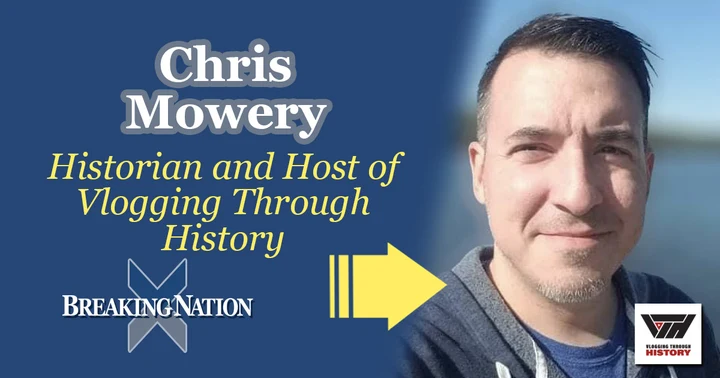
Interview with Chris Mowery


In this Breaking Nation interview, historian and YouTube host and creator Chris Mowery discusses how a childhood fascination with the Titanic and Civil War films sparked his lifelong love of history. He shares how that passion grew into Vlogging Through History, a YouTube channel with over half a million followers dedicated to exploring forgotten stories from the past. Mowery reflects on the challenge of predicting what resonates online, the joy of building a global history community, and his drive to highlight the human side of war. He also previews his upcoming book, Trumbull County Boys, about Ohio soldiers in the Civil War.
Check out our website at http://www.breakingnation.com
Breaking Nation: A Civil War Podcast is a production of Waveland Creative.
Host: Scott Holmgren
Welcome to the podcast. Today we're joined by historian and YouTube creator Chris Maury, the voice behind Vlogging Through History. We'll dive into his journey uncovering forgotten stories, explore the human side of the Civil War, and hear about his upcoming book, Trumbull County Boys, Capturing the Lives of Ohio Soldiers. Welcome to Breaking Nation, a Civil War podcast. I'm your host, Scott Holmgren. My goal is simple to bring the American Civil War to life by exploring and discovering the people, the places, and the events of this critical era, as if we didn't know how it would turn out. I can't wait to get into this special episode to have historian and author Chris Maury on the podcast to discuss the relevance of the Civil War today and the case for learning from history. Hailing from the great state of Ohio, Chris Mowrie is the creator and host of the popular YouTube channel Vlogging Through History, a community of over half a million subscribers. As a respected public historian and a member of the prestigious Gettysburg History Council, he combines scholarly integrity with modern media savvy to bring the forgotten stories of our past to life for a new generation. He is currently writing Trumbull County Boys, the story of Company H, 20th Ohio Volunteers in the American Civil War. It is my pleasure today to have Chris Mowray as my guest on Breaking Nation. Good morning. Good morning, Scott. How are you doing? Very good. Thanks so much for joining me and uh for sharing and for talking this morning. I'm so looking forward to this. I'd like to start by finding out a little bit about your background, how you embrace the disciplines uh and calling of being a historian, and then turn and look at history in general and the Civil War in particular. Um so really to help get to know you better, when did you know you were into history? Uh, or you wanted to study and write about it?
SPEAKER_01So it started for me, uh, interestingly enough, in 1985 when Bob Ballard found the Titanic. It was all over the news. You know, I didn't know anything about the Titanic. I'd never really heard about it until then. But there was something about that story that grabbed me. And I went down uh at that time, of course, we didn't have the internet. Uh so our local library was the William McKinley Memorial Library, which is uh built next to his birthplace in Niles, Ohio. And uh I went and got every book that they had on the Titanic and just obsessed over it for months. And that kind of was my introduction to history and my introduction to my obsessive nature when it comes to when I get into a topic, I obsess over it for weeks or even months until I've absorbed everything I can on it, and then I move on to something else. And um, the other thing for me about that time was there were all these Civil War mini-series that came out on TV. It was North and South, and then North and South Book Two, with you know Patrick Swayze um and all those characters, and uh, and then you had um Gore Vidal's Lincoln, starring uh Sam Waterston as Abraham Lincoln. And those two things, and then a few years later, uh you have the PBS uh Civil War documentary by Ken Burns, and those were the things that got me into the Civil War, and that became kind of my lifelong obsession as far as history goes, the Civil War, and then more recently World War I. But uh those are the things that got me into it, and by the time I was in high school, I was pretty sure that I wanted a career in history of some kind.
SPEAKER_00Wow. Wow, were there any books particular? Like for me, it was always going to the library and oh, there's the one book, and I would check it out over and over and over again. Were there any texts or books that you would read repeatedly or really inspired that?
SPEAKER_01So, yeah, there was um Time Life came out with that whole series of books on the Civil War. I think I have some of them on the shelf behind me, uh, and one after the other. My I was raised by my grandparents, and my grandparents really um embraced this obsession that I had with history, and so they would buy me all kinds of books. There was uh I I used to get a subscription to uh Civil War Times Illustrated, the magazine, and that would come and that would feed into it. And uh, and then I had wonderful mentors in high school, like my my school principal and my history teachers who would give me books from their own shelves to take home and read. And um, I just got anything I could get my hands on.
SPEAKER_00And certainly where you live in Ohio, it it it there's a there's a fertile soil for history in the Civil War, especially so many presidents from there and so many famous regiments from there. I'm sure that that fed into it. And I know I've listened to you and some other things talk about your own history, so your family is a country contributing factor. Uh, when did that begin to actually become a thing? Like, oh, this this is in my blood or my DNA almost.
SPEAKER_01Yeah. So uh it was actually my senior year of high school, my best friend, uh, her name was Amy, and her dad started getting into genealogy. And from him, that kind of rubbed off on me, and that became my other lifelong obsession was family history research. And it started out with me just wanting to know names and dates, kind of like how a lot of people learn history, which is okay, this battle happened on this date, but pretty soon I started to realize that what was really interesting to me in history was not the names and the dates, it was the stories. It was who those people were. And um, you know, so discovering things like okay, the Battle of Gettysburg is interesting, but it's really interesting now that I found out that my fourth great grandfather was in the 4th Pennsylvania Cavalry on Cemetery Ridge, and from where he was standing guarding artillery on July 2nd, he could see the 57th Pennsylvania in the peach orchard, and his son was in that unit. And, you know, starting to see those family connections just made history come alive to me in a way it hadn't before.
SPEAKER_00Wow. Yeah. I've done a little bit of genealogy uh exploring. I have yet to find any ancestors for myself, only through my mom's side. Really? So yeah, it's it's different. I probably haven't dug deep enough. So I that's that's more of a uh a pursuit for me to keep going. Um so, in terms of then as you got older, in terms of your schooling, right, in terms of uh uh a career as a historian, uh, did you go to school for history? How did that go? Talk about kind of then as you developed in your profession.
SPEAKER_01Yeah, so um I did. I uh I went to uh initially went to Teal College, which is this little um thousand student school in northwestern Pennsylvania. Uh and the reason I chose Teal wasn't anything to do with history, it was actually because um I ran cross-country and and I got recruited by them to run cross-country and track. So that's what I did there. Um, but yeah, I had some incredible professors there. I uh majored in history and secondary education. Uh uh my my plan had always been to be a history professor, to end up at a university somewhere and teach. Uh, but life has a funny way of throwing you a curveball. And in my case, it was uh it was actually completely out of left field. Um, when I was in high school, my senior year high school, um, some friends and I started a chapter of Fellowship of Christian athletes at our school. And it's still going strong there. And it was actually my history teacher, who also happened to be my distance coach, who was our uh uh our kind of faculty advisor for that. So I had all these connections to him. And uh so when I got into college, I thought, well, I'll join FCA. And I showed up to the first FCA meeting, and there were four of us there that night, and they were electing four officers. And uh, so I got elected the vice president of the Teal College chapter of Fellowship of Christian Athletes, started leading Bible studies. Next thing I know, despite the fact that I go to school for history, I ended up going into a career in youth ministry. Uh, so I never ended up teaching. So history kind of became, even though I had studied it in college, and that's what I went to school for, it became this kind of side project for me, and I got away from it and I spent four the next 14 years uh in full-time ministry and uh wasn't sure that history would ever kind of come back on the radar for me.
SPEAKER_00Wow, what a what a journey. Yeah, real life gets uh happens sometimes. So obviously now vlogging through history is amazing. It's it's a it's an entire entire channel that you have. How did that start and grow? What was the genesis for that? How did it begin get us up to speed?
SPEAKER_01So, like a lot of things, it it had a lot of twists and turns. Um, I I I was doing ministry full time, I left ministry full-time, was doing music for a while. Uh, I uh was writing and you know, performing a lot of music, and uh then I started speaking for an organization called Rachel's Challenge. Um, my daughter, who is 20 years old now, uh, we named her after the first student killed at Columbine. Uh her name was Rachel Joy Scott. And I had always been just blown away by Rachel Scott's story, was really impressed by it. And uh so we named our daughter after this girl that we had never met, and um ended up getting connected with Rachel Scott's family and went to work for them as a national program presenter for Rachel's Challenge. So I'd travel to schools all over the country speaking in schools about kindness and compassion, things like that. But I would be like full-time three months out of the year, and then the other nine months I was sitting around at home. I was a stay-at-home dad, I was cooking all the meals, driving to soccer practices, coaching, stuff like that. So I thought I need something else to do. And uh I started a gaming channel in 2016 called The History Guy. And uh basically what I would do was I would play a strategy game, and if there was history, so if I'm playing the Battle of Gettysburg, I would talk about the actual history behind the game I was playing, and I would use that as an outlet for it. And um so that went on for about four years. And as I was traveling for Rachel's challenge, I would occasionally uh the guy who booked all of our travel knew that I loved history, and so he'd always try to send me, like if there was a school outside of Boston, he would send me because I always wanted to go to Boston and see the history there. And uh I would make these little, I would just take my phone and I'd make like here I am on the Lexington and Concord battlefields, and let me show you around a little bit. I would upload those to my gaming channel, but they never really got any traction. And as I learned more and more about how YouTube worked, I realized that YouTube doesn't like it when you do two different kinds of things on the same channel. So what I ended up doing was then I thought, well, I'm gonna start a separate channel just for these vlogs. Called it Vlogging Through History. And then right about the time that I started the channel, COVID hit and I couldn't travel. Uh, you know, when when your job is to speak to large crowds of people in confined spaces, COVID shuts that down. So um I was sitting around, I had this channel that I had started that had no content on it, and somebody on my gaming channel said, Well, while you're waiting to travel again, why don't you do reaction videos? I'm like, that's a terrible idea. I hate reaction videos. So I'm like, all right, you know, I'll do it. So I I started out by like looking for a few videos about the Civil War. That was my passion. And uh I would sit there and I kind of used it as my textbook, right? I'd watch what they were saying, and then I'd say, well, let me give you a little more background into this. Let's go a little more in depth on this, and I would kind of break it down. You know, I didn't ever want to be one of those people that was just watching someone else's video and then, oh wow, that's interesting. Ooh, wow, cool. You know, I wanted to add value to it. And so I started using those videos as my textbook. And within three months, I'd hit 100,000 subscribers and was doing it full time, and that's been my life for the last five years.
SPEAKER_00Wow, what an amazing story. I I agree, you know, I I like reaction videos for music, and it's always fun to hear a song the first time through somebody else's ears, right, as they're listening to it. But unless they're really a musician and they can call out things after a while, it's like sitting with your best friend listening to something, right? So I I totally get that. Um, I mean, vlogging through history now has reached over a half a million subscribers, which is amazing. That's got to be so encouraging. But what have been some of the greatest challenges and the greatest blessings of producing it?
SPEAKER_01Uh well, uh, challenge-wise, um one of the challenges, of course, with anything you do when it comes to producing content, whether it's a podcast or you know, YouTube channel, is you never know from one month to the next how it's gonna go. You know, you can have something, you think this is gonna be the big thing, and people are gonna love this, and you put so much time and effort and and and heart into it, and then it just completely flops. And you're like, I don't understand what I'm doing. Why did people not like this? And then you'll do something else that you just think is not great, and it takes off. And I I think so. The biggest challenge for me is just that every time you think you have it figured out, you don't. And everybody I've talked to, I've gotten to know a lot of people that uh do YouTube and podcasts and stuff, and they say the same thing. They're like, I don't have a clue what's gonna work and what doesn't. Um, but the blessing, and this is completely unexpected, is the community. Um, you know, here I was in a family where, you know, most people in my family didn't really care that much about history. My grandfather, who raised me, did. He's gone now, but um, you know, passionate about history, and I loved sharing this stuff with him. But for the most part, you know, I was kind of this history nerd just talking to the air, you know, and and so having this incredible community of people that I've gotten, and many of whom I've gotten to meet in person, some of whom have become really good friends, all through this uh YouTube channel that I created. And and now I'm doing all this travel and doing these group trips, and um, yeah, I just I did not expect how much I would just come to love the community of people that have built up around this channel.
SPEAKER_00That's amazing. Your your your first answer to the challenges reminds me of the William Goldman quote screenwriter who wrote Butchcasting and the Sundance Kid and all that. He's famous for saying in the film business or in the storytelling business, nobody knows anything. In other words, there's no way to know. You'll never know. And that is, I can identify with the frustration around that. So you pour your heart into something that uh that's that's a hard thing. Um, I know that besides the reaction videos, there is a lot of other media that you produce uh around some of the things you already mentioned. Tell us a little bit more about that. What are some of those dreams that you have for those those productions?
SPEAKER_01So as I mentioned earlier, uh Vlogging Through History was never meant to be a reaction channel, it was supposed to be where I posted these historical site blogs, uh vlogs. And uh what ended up happening is because the channel grew on the strength of those reaction videos, anytime I would upload the vlogs, they flopped. They did terrible because most people weren't there for that. And so that then led me to kind of create these other channels. And if you ever see somebody who's got like 10 YouTube channels, that's why. Because the funny thing about the YouTube algorithm is it likes you doing more of the same, and it kind of promotes that and and rewards that. And so um, stories of the Civil War, stories of the Great War, uh, have kind of become the niche channels for me where um those are my two great passions when it comes to history is World War I and the Civil War. So I I've kind of focused heavily on uh uh battlefield vlogs for those two, and then podcasts that go along with that where I can go a little deeper with the stories than I can in a battlefield vlog. Um, and then I have a one that's called VTH Extra, which is for all the other stuff that doesn't fit anywhere else, or I get to talk about music and and talk about my faith and uh all of those things that just don't have anywhere else to go. So that's what I do.
SPEAKER_00Um we mentioned the Civil War book that you're working on as well. Yeah. Uh along with that, are there other new projects in the works, things that are coming up, maybe to drop a little hint about what what people can look forward to?
SPEAKER_01Yeah. So um in addition to you know, like the site vlogs, I've got, you know, I've got some stuff coming from the Stones River and Franklin battlefields that I just shot that'll be going up on stories of the Civil War. But um, yeah, um, I'm actually already thinking about the next book, uh, which is gonna be another local one. And I I know we're gonna talk about um uh Trumbull County boys here shortly, but uh I live in a little village called Poland, Ohio. It's outside of Youngstown, and it's called Poland because uh it was a way for Revolutionary War veterans to honor the Polish contribution to the revolution, uh, which doesn't get talked about a lot either. But uh one of the local companies that was raised here was Company E of the 23rd Ohio. They were called the Poland Rifles. And one of the privates in that company who grew up about 200 yards from my house uh was an 18-year-old private named William McKinley, uh, who went on to become president of the United States. He was in the Poland Rifles, and their uh original lieutenant colonel was Rutherford B. Hayes, who also went on to become president. And uh, so there's a story there, I think. Uh so I think down the road I'm gonna probably start digging into the Poland Rifles and and tell their story at some point.
SPEAKER_00Wow, that's that's incredible. I look forward to hearing more about that. Um, let me talk uh uh let me ask a little uh question about when you sit down to produce or to write or when you do the actual creative process of determining your content and how you're gonna build that. Do you outline as you go? Do you do you sort of build a structure that you fill in? Uh, how do you set goals as you research and write? Uh let us inside the creative process a little bit.
SPEAKER_01Sure. So uh number one, I have to say up front, and this is, I guess, probably true of a lot of creative types. I'm terribly unorganized. Uh organization and um just kind of staying on top of myself has never been my strong suit. Uh, so I have to be very intentional about that. I have to make a lot of checklists uh to keep myself on task. Um, and the other problem I deal with is I love research so much that sometimes I have a hard time transitioning from research to actual writing and producing. Uh, or I love filming, but then I have a hard time with editing, you know, stuff like that. Um so for me, uh, give you a great example because this is recent history. I just got back from France where I did a bunch of um uh battlefield vlogs uh for stories of the Great War. Um so I sit down a couple of months before a trip like that, and I first of all kind of plan out where am I gonna go. And when when I go there, let's plan out like three videos a day that I'm gonna film. Uh, and so I'll kind of lay out at least the topic. And then once I have the topic, then I start thinking about what story do I want to tell. Um, because for me, there are plenty of documentaries out there, for example, that can tell you about the Battle of the Somme and what happened, tell you what division fought where and that kind of stuff. I'm not interested in doing that with my channel. My channel's about let me go to this spot where this one particular battalion fought. Let me tell you about some of the men in this battalion and what they experienced on one day of the battle. Uh, and so those are the stories I look for, as I look for the untold stories, I look for the the individual nuggets about soldiers that nobody's ever heard of. And then I start digging into them. And I use my genealogy background to try and find out the background about these guys, where they came from, who their families were. Uh, and another thing lately that has been uh a trigger for me in terms of deciding what to write about uh and what to film about is I've really gotten into collecting memorabilia from these time periods. So I just got back from France and I went to this little village, and right outside this village, there's this tiny uh stand of trees called Gauche Wood. Nobody's ever heard of the battle of Gauche Wood because it was September 18th, 1918, and it was this one-day battle by one battalion outside of this little village in France as part of what everyone knows about, which is the Hundred Days Offensive. And the reason I went to Gauche Wood is not because I knew anything about Gauche Wood, but because I have the ID tag that was pulled off the body of a soldier uh from Cumberland in England named John Joyce, and he's buried at Gauche Wood Cemetery. He was killed that day. So I went there with his ID tag, with the telegram that was sent to his wife to announce his death, uh, and I just told the story of what happened that day. And so that was what led me to tell that story is having those those items. And and those are the stories I think people connect with because I can't connect with a general ordering a division into battle, but I can connect with a guy with a a wife and small child back home who's fighting for the guy next to him and just wants to survive the war and get home to his family. That that is a story I can connect with.
SPEAKER_00Yeah. Wow, that's amazing. That's the opportunity to go to the places, right? And actually stand in the spot. That's incredible. Uh, last question on the creative process. What have you learned about yourself or your process over the years as you've been doing this and had getting more experience? What is the greatest takeaway personally for yourself?
SPEAKER_01Yeah, I I think what I just alluded to, which is initially when I started this process, I was telling big stories. I was like, okay, here's here's the sunken lane at Antietam. Let me tell you about the three union divisions that attacked here, you know. And as I got along, I was like, man, I'm I'm everybody tells that story. I want something different. And so I I've just found that the stories I tell and the videos that I make reflect my own interest and my own personal connection to those things. And so I think that I've learned about myself. That my interests have changed as I've gotten older, as I've matured, as I've I'm now a dad with three pretty much grown children. Um the the stuff that interests me about history isn't one that interested me when I was 18 or 20 years old.
SPEAKER_00Very, very self-aware. That's awesome. I appreciate that. Let's pivot a little bit. Let's talk about history now in general. Let's talk about, you know, we live in a world where history, you know, has kind of been taken away out of the classrooms in a lot of places and people aren't as interested in it, or they only talk about certain parts of history and ignore other parts. One of my favorite quotes is from John Gardner, who was a uh U.S. Secretary of Health, Education, and Welfare. And he once said that history never looks like history when you're living through it. In other words, we're all a part of history, right? And so that stigma that history is boring, it's simply a list of names and dates. Uh, how have you made connections with people that help them see history differently? Like how have your stories impacted people?
SPEAKER_01Um, yeah, I think he's absolutely right about that. I mean, I think there are occasionally times when we know, you know, those of us who lived through 9-11, I think we all understood we were watching history that day as it unfolded. But for my kids, 9-11 is not something they lived through. They connect to that very differently than I do because I was sitting there watching it happen on live TV. They're reading about it in the classroom. 9-11 for them is what Pearl Harbor is for me and you, you know. Um, so they do connect to it differently, uh, for sure. Um, I think it goes to what we've been talking about is that finding for me personal connections makes history come alive. Uh, I see the battlefield at Vicksburg so much differently when I know that my fifth great grandfather was 53 years old and in those trenches. Uh, and I go to the site where right in front of the third Louisiana Redan, there's a monument that says this is the extent of the 20th Ohio's advance on uh in May of 1863. I stand there and with my son, who was 12 at the time, my son Eli, and we stand there, and you know, it's not just faceless, nameless guys in blue attacking down that road. It's my family who attacked down that road. That makes it so much more important and so much more impactful to me. And so uh I try to help people to kind of tap into that. And I I so encourage people to research their family history because it does give us a personal investment and a connection in those events. Uh, and it also helps us to unlock events we didn't think we cared about. You know, I I grew up learning all about, like a lot of people, the Eastern theater of the American Civil War. Most of my ancestors who fought in the Civil War were in Kentucky and in the West. I didn't have much family in the East. I had one guy who was in the 4th PA Cavalry that was in the Army of the Potomac. So finding out about the 20th Ohio and finding out about the units in Kentucky unlocked parts of the war I knew nothing about and caused me to want to know more about those things. So I think that that helps too.
SPEAKER_00Yeah. We weren't there, but our DNA was, right? That that's that's such a powerful truth. Yeah. Um, one of my favorite historians is David McCullough. I'm sure he's a lot of people's favorite historian, right? His voice is like sort of like the narrator of the Ken Burn Civil War.
SPEAKER_01For sure.
SPEAKER_00Absolutely. I love some of his quotes because I think they help they help uh conversation uh flow from it. He once said this: he said, there's no secret to making history come alive. Because Barbara Tuckman said it perfectly. Tell stories. The pull, the appeal is irresistible because history is about two of the greatest mysteries of all time: time and human nature. So why are those so powerful for you? And then how do you navigate that in your work?
SPEAKER_01Uh oh, it's absolutely true. Um, I try to put myself into those stories. What would I do? You know, and I see things so differently. You know, I I did a video a while back about um the the 300 or so British soldiers who were, as they say, shot at dawn during the uh the first world war, executed for desertion. And growing up, I had this kind of bravado that thought, well, those guys were cowards. Why would they desert their their fellow soldiers? Now I am older and I look at those stories and I think, well, those guys were suffering from some severe trauma that they went through. Uh, they called it shell shock then. We call it post-traumatic stress today. But either way, I look at them and I think, you know what? I probably would have done the same thing. Uh human nature, I think, gives us a connection to those events and helps us get inside the head of people. You know, understanding, you know, Robert E. Lee, what was he thinking when he ordered the charge at Gettysburg on July 3rd? Well, he had just gone through several months of being pretty much invincible and just getting whatever he wanted on the battlefield. And if I was in his position and I wanted the war to end, I might have done the same thing. 160 years tell me it was a bad idea. But at the time, putting myself into that mindset, into the human nature of the moment, I think I might have acted differently.
SPEAKER_00Yeah, yeah. Whether it's decisions or like compassion, right? The story of the angel of Mary's heights. You just don't know what, and I often find myself asking that question, what would I have done? And it's embarrassing because I probably would have run or I would have, you know, you just don't know when those moments of heroism or cowardice are going to rise up or not. Um, another quote that I love that McCullough said is this one. It's a little bit longer, but it gets at the the gist of teaching and learning through history. Uh, he said, What history teaches, it teaches mainly by example. It inspires courage and tolerance, it encourages a sense of humor, it is an aid to navigation in perilous times. We are living now in an era of momentous change, of huge transitions in all aspects of life, nationwide and worldwide. And this creates great pressures and tensions. But history shows that times of change are the times when we're most likely to learn. I love that quote. So, what are some things you've learned? And we've talked about them, but specifically, what are some other things that you've learned that have most shaped you through your study of history?
SPEAKER_01Uh, one thing is that um I know everybody likes to say history repeats itself, but as I often say, it doesn't repeat itself, but it does rhyme. Uh and uh one of the things that I it's given me perspective. There's a lot of people today, for example, that think, well, things have never been worse than they are right now, or COVID was the worst thing we've ever gone through. And I thought, man, you go back and tell that to somebody who was born in 1900, that this is the worst thing in history. Uh, and that gives me that perspective. And I think, well, you know, that generation, they lived through World War I and then they had a global pandemic that killed like 5% of the population. Then they had a depression, then they had World War II. You know, I mean, just by the time those people were my age, they had gone through all that. And suddenly the world seems pretty amazing right now by uh comparison. So I think history has given me that perspective to think that there's nothing new under the sun, and I'm not going through anything that other people haven't gone through and far worse in their lives. And it makes me grateful to be alive when I am with the knowledge that's available to us, with the technology that's available to us. Um, and I'm just grateful.
SPEAKER_00Yeah, yeah, it certainly does remind us of uh how good we do have it, in spite of what the headlines often say. Um, in terms of the Civil War now, okay, so this is a Civil War podcast, and that's really where I spend most of my time, and I know it's a passion of yours, but I really want to ask you some questions because you have talked with a lot of people and you do interact with this amazing community. So my question is is a general one. How is the Civil War still relevant history for Americans? It seems in the news, those two words civil war pop up a lot over the last, you know, several election cycles or whatnot. And certainly it's you see it on TV programs or whatnot. So it's it's uh relevant sort of in a pop culture sense, but it's also relevant in a national identity sense. How how is it still relevant?
SPEAKER_01So for me, there's a couple of things that I see. One is it shows us what happens when we stop talking to each other. Uh, you know, when we stop talking and violence takes over, and the Civil War didn't happen out of nowhere. It was a buildup, I mean, over decades uh of escalating violence, escalating tensions, and pretty soon people were just like, we're done talking, let's see you on the battlefield. But it also shows us what happens when we don't deal with problems. Uh, because basically every generation going back to the revolutionary generation, the founding fathers kicked the can down the road on slavery. And it just kept snowballing, and nobody wanted to deal with it. They all just looked for band-aids and never fixed the problem. And eventually it escalated into a civil war. And so I I think it's relevant in that sense. It's it it should be a cautionary tale for what can happen if we don't deal with our problems and we don't figure out a way to compromise and talk it out. Um, but more than that, I think uh we still see, whether we realize it or not, we still see the elements of that. Um, and and I've talked about this some uh all history is connected, and uh, you know, every event is a culmination of the things that preceded it. And as a genealogist, just going back to looking at who settled the south versus who settled the north, uh, the north is very much settled by the English, uh, and then later the Germans. In the South, you have a ton of Scots-Irish. Uh, and these are folks who come over kind of looking at government with a side eye. Um, they come over with their clan mindset from you know the Scottish Highlands and things like that. And so there's always been this element, for example, in the South and in Appalachia of mistrust of the government, of small government, local government versus big government. We saw that reflected in the Civil War. We see that reflected in the politics today. Um and so it's again, it's in our DNA. I mean, that my family came primarily from eastern Kentucky. These were Revolutionary War veterans who were Scots-Irish who settled there, and that clan warfare that went on uh between like the Hatfields and the McCoys, uh, and then my own family was part of something called the Holbrook Underwood feud, which was actually the deadliest feud in American history. Um, that was a direct transplant of the Klan fighting that went on in the Scottish Highlands a couple hundred years earlier. Um, so it's all connected, it's all one thing after another.
SPEAKER_00Yeah, yeah. Um, what's amazing is uh how it still captures the imaginations of people. I was just at a reenactment a few weeks ago in Jackson, Michigan, not far from where I live. And, you know, you see the families out there and there's kids, and and there really is an interest, right? And and I remember years ago, back during the you know, the 1980s when they had the 150th anniversary and there were a lot of huge reenactments. I kind of figured that would wane a bit, some of that enthusiasm or the interest, but it still isn't. Why do you think it captures the imagination of so many people these days still?
SPEAKER_01I think for Americans, it's accessible to us because uh, you know, I go to Europe to see World War I and World War II battlefields. We don't really have that here, um, unless you're in Hawaii and you have Pearl Harbor or something like that. Uh for Americans, especially in the eastern United States, we've got battlefields. We've got Gettysburg. I grew up going to Gettysburg. You know, it's four hours away from me. So that history is more accessible. You live in the American South, you got American battlefields, American Civil War battlefields all over the place, and Revolutionary War battlefields uh all over the place. And so I think it's more tangible for Americans uh than uh some of those other wars that we fought in because they happened on Foreign Soil. So I think for at least for me, that was why it captured my imagination growing up.
SPEAKER_00Yeah, yeah. Certainly, certainly it's great to get in the car, go visit, you know, walk the fields, imagine, bring a good book that can guide you through it as well sometimes. Um so with this imagination, then obviously we often infuse our imagination into the facts, right? And there's a lot of misconceptions about the American Civil War. Um, and we hear them all all the time. So for you, as you interact with folks or you get responses to the things you produce, what are some of the most significant misconceptions about the war that that you think need to be addressed? We we do have to call them out because it it matters, it is important.
SPEAKER_01Um, I think there's still, I mean, I I think it's changing, but I think there's still this idea that all the great generals were in the Southern armies and there were no really good generals in the North. The North won because of an industry and all that stuff, and part of that is true, but there were some really, really good generals. I mean, Ulysses S. Grant is one of the best generals in American history, and people don't realize just how good this guy was. Sherman, fantastic. McPherson, great generals. Um, you know, the North had every bit the good generals, especially at the higher command level by the end of the war. We had to get through some people for that to rise to the top. Um, but uh the another can misconception, I think, is this idea that guys were having their arms and legs cut off without anesthetic all over the place. Like 97% of amputations that were done in the Civil War were done under anesthetic. It was really, really rare that it didn't happen. And it was usually at a big battle where they ran out of uh of chloroform or ether and things like that. So they weren't doing that all over the place. It was really rare that that happened. Um, and another one I think is that the Civil War was all fought in Virginia and Maryland and Pennsylvania. You know, there's so many interesting stories out west. Uh, there's, you know, most of the guys that you research that fought and died in the Civil War died in places you've never heard of. Died at Raymond, Mississippi, died at Mill Springs, Kentucky. Uh, these little skirmishes, hundreds of them all over the place that people never talk about.
SPEAKER_00Yeah, yeah. One of one of my pet peeves is is uh somebody will see a picture of armies lining up, right? And big long rows, mass men, and they'll just say, Oh, that was so stupid. That was so stupid. You know, and the the misconception that you don't think they knew what they were doing. Like there's a reason for that, and the technology and the Napoleonic tactics, and then getting caught up with that and how the face of the war changed dramatically over the four years of fighting, and it devolved basically almost into trench warfare in certain places where that was necessary. Um, so I think it's important, like you said, I I love the fact that in your videos you want to bring added value to draw attention to let's let's learn the rest of the story. So um, so important. In terms of your book, then Trumbull County Boys, I I did want to read a little excerpt uh as a tease uh because it's just so appealing, so interesting to me because of what you've said thus far. Uh this is from the prologue. You write, quote, the regimental shelves of American libraries already groan with titles. However, most volumes are either terse official histories penned by veterans for other veterans, or modern battle studies that strip the protagonists to numbers on an order of battle chart. Few linger long enough in the courthouse squares and late night fires of the volunteers to show us the full arc of a common soldier's life. End quote. I love that. What a what a great introduction, what a great setup for your story. So, what inspired you to begin this book on Company H of the 20th Ohio?
SPEAKER_01So it started with what we've talked about already, which was genealogy. Um I I I'm very lucky I have 13 direct ancestors who fought in the Civil War, four, four for the Confederacy and nine for the Union. Um, family being from Kentucky, that happens. But where I grew up here in Northeast Ohio, only one of my Civil War ancestors was here. And he was in the 20th Ohio, and he was the oldest man in the company. He was 53 years old when he enlisted. The youngest man in the company was the company's drummer, who was his youngest son. Uh, and part of me thinks that's why he enlisted was to keep an eye on his son. But um, so that was uh initially what happened. And but what led me to want to write the book uh is I was in Vicksburg and I was doing a series of videos on the Vicksburg campaign, and I got to the banks of this little tiny, like three-foot-wide creek outside of Raymond, Mississippi, called the 14 Mile Creek. And I went to the exact spot where the 20th Ohio was fighting that day, and I had in my hand a diary written by a soldier in Company E named Osborne Oldroyd. And a lot of people are familiar with that diary. He kept a diary during the Vicksburg campaign, and I read his diary entry from the battlefield at Raymond about what happened that day. And he and he's telling these little details, like he's talking about his bunk mate, the guy he shared a tent with uh named uh Cal Waddell. And he's talking about how he's combing his mustache before the battle, and the guys are joking with him about the rebs don't care if you comb your mustache before you fight, and and they're playing cards and they're doing all this stuff, and then he goes on to describe how out of nowhere shots ring out and they rush to the side of the creek and they're fighting, and at times they're getting close enough to where the the shots they're firing could burn the clothes of the guy they're shooting at. And he's talking about this one rebel soldier with a red shirt, and they're all taking shots at the guy with the red shirt. And then he talks about how as they're kneeling at the creek, a ball crashes into Cal's brain and they drag him back. And and there were details that I had never thought about until I knelt there at the creek and I'm reading exactly what happened on the exact spot, and I thought, people need to know this story. So I sat out, uh, set out with the idea of writing a book on the entire 20th Ohio. And as I started doing the research, I I was so buried in information. There was so much there that had never been tapped into. You know, it just blew me away. Like I just didn't think there'd be that much there. That I ended up having to narrow it down just to the one company that Sam Hughes, my ancestor, was a corporal in Company H, which was the only company in the regiment that was from Northeast Ohio. The rest of the regiment was from Knox and Shelby counties, which are more of the central part of the state. And uh, and I'm still overwhelmed with information. I there were 134 men in the regiment, and I did genealogical research on all 134 of them. I visited all their graves, I got into their pension files, their military records, uh hundreds of letters that were written to the local newspapers, um, photographs, everything. It just I couldn't believe how much information was actually available on this one company of men. And I spent three years doing the research and finally had to say, you know what, I need to start writing this book because I need to get this out there. Um, and I'm really excited for people to learn it because learn about this because it is. It's the story of the day-to-day life of soldiers. Band of Brothers is what inspired me. You know, Band of Brothers, I think, captured people's attention because it wasn't about the entire war. It was about one company of soldiers, and it told their stories, and you got to know them and you got interested in them, and you wanted to know their lives after the war. And, you know, people have become obsessed with these people that were just regular soldiers doing their jobs, and that's who these guys are.
SPEAKER_00Yeah. Wow, that's that's quite a journey for you. Quite powerful just by a little creek uh there in uh you know by by the battlefield. That's amazing. Is there been a most surprising discovery as you've done all this research? I mean, over a hundred guys, and you you um as you've gone through all this information, there had to have been something that was like, oh my goodness, like what has been the most surprising discovery from the whole thing?
SPEAKER_01Yeah, uh so part of the story, um initially they didn't have their full complement of soldiers for the company. And so uh Lieutenant Edward Downs, who was the first lieutenant, the the XO of the company, um, while they're while they're encamped at Camp King, which is in um Covington, Kentucky, right outside of Cincinnati, uh, he takes 10 or so men back home to Warren, Ohio, to do some additional recruiting uh to get some more men. And while he's on his way back, somewhere like around Akron, they're at a train station, and this guy named Lorraine Ruggles walks up to them and uh he says, Hey, what unit are you guys with? And he says, Company H, 20th Ohio. And he goes, You look like good soldiers. If you can get me an Enfield rifle, I'll join your company. And they're like, All right, deal. So they sign this guy up. He's not from Trumbull County, he's not from the local area, but he just has this random encounter with them. And uh so he joins the company and he he's grown up like he's from Northeast Ohio, but he's lived a lot of his adult life in the South. And so he's got a southern accent, he knows these people, he's got the same last name as a Confederate general, Daniel Ruggles. And so he starts telling people that he's the brother of Dan Ruggles, he's not. Um but so he's a part of Company H, but pretty quickly he gets enlisted as a scout, uh, first for General McPherson and then for General Sherman, and then later for Grant. Uh, and they start sending him behind enemy lines. He he goes behind the lines, pretends to be a Confederate soldier, tells people he's Dan Ruggles' brother. Uh, and really, if if the guy had been caught, he would have been hanged. Uh and uh so he's one of the guys in this company that just, I'm like, holy cow, this is an amazing story. And then in 1866, right after the war, he writes a book, and it's ghostwritten by Lieutenant Downs, the guy who had enlisted him, who ended up being the company commander uh for most of the war. And so in 1866, they published this book, and I've got the book on my shelf. Uh, and it became a huge resource for me because he tells all of these stories. Like uh one time he talks about this event called the chicken scrape, where they're in Kentucky and it's in the first chapter of the book. Uh, there's this woman who uh sees their men marching by one day and she yells, Hurrah for Jeff Davis! And well, it didn't sit well with the guys, and so a group of 20th uh of Company H guys go out that night and they sneak onto her farm and they steal her chickens. They take them back, they kill the chickens, they eat them. Uh, and Manning Force, who is the um the regimental XO and later becomes the commanding officer of the regiment, fantastic soldier, and he has an amazing name, Manning Force. Um, Rutherford B. Hayes names a son, Manning Force Hayes, after this guy. Wow. Uh Manning Force comes to Lieutenant Downs and Company H and says, What's I'm hearing, you stole this woman's chickens. You can't be doing that. And he starts like questioning the men, and no one will fess up to anything. And they had eaten the chickens, they had buried the bones, there was no evidence whatsoever that any of it happened, and they get off scot-free with no punishment for any of it. And that's a story I never would have known about, except that Lorraine Ruggles wrote this book and told the story about the chicken scrape, which became like part of the lore of Company H. And so those are the kinds of stories that are in the book that I'm really excited to tell.
SPEAKER_00That's awesome. What a what a story. That's incredible. Um, so it's called Trumbull County Boys. Do you have an idea of when you might be done with it?
SPEAKER_01Is it uh I'm I'm I'm thinking spring 2026, it should be available. Um, I'm probably about a third of the way through the writing process. So we're wow. We're getting there.
SPEAKER_00Well, congrats, that's a lot of work. Good job. Um, last question, really, around the Civil War specifically, is is on military history, right? So so you've alluded to the fact that for many people it comes down to the generals and the big battles and the divisions, and you know, it can become very analytical, right, as opposed to the story-driven kind of parts of history. But military start history still has a place, right? And so my question was is, you know, how does that have usefulness? Where do you see military history outside of the military still having uh uh value to Americans who may not know enough about it or needs need to learn or go visit a battlefield? Uh speak a little bit about that.
SPEAKER_01So I think military history still has a huge place. I mean, there's a couple things. Number one, most of us all know somebody who's in the military currently or is a veteran. Um, so by studying, you know, the experience of soldiers in the Civil War, it helps me understand a little better what my uncle went through in Korea or what my cousin went through in being deployed over in Europe, training anti-terrorism forces and things like that. So I think there are certain aspects of military history and the the experience of the common soldier that are universal, no matter what time period you're talking about. Um but also um I think there is just something about military history that captures our imagination because it it reveals the best and worst of us. Um you know, because people who otherwise don't um have opportunities to reveal their humanity for good or bad, um, the military gives us those opportunities. You know, you mentioned earlier the story of Richard Kirkland, the angel of Maurice Heights. Um that that that didn't that event at Fredericksburg where he went over the wall and was giving water to Union soldiers, you know, he didn't become that person that day. That revealed who he already was. Uh and and it's just that he was a person who already was of compassion, who was a man of great faith, who was put into a situation that most of us will never be in, where his enemy is laying in front of the him on the battlefield crying out for water, and his compassion was revealed in that moment. Um, and so military history provides a unique lens into the human condition and the human psyche and and how we operate. And it also reveals the worst. You know, some people, um the worst of who they are is revealed, and that's how we end up with massacres and we end up with the atrocities that we see on the battlefield. Somewhere deep inside that person, there's something that's flawed and broken, and it gets unleashed in a situation where it can be unleashed. Um, so I think it's a great study and just who we are as humans.
SPEAKER_00Yeah, yeah. No, I I I agree. That's that's an awesome uh unpacking of that. All right. Well, again, thank you, Chris. I have one last question. Uh, this is kind of the classic question for anybody who loves history, right? So you're having dinner, right? You're gonna make dinner, you get to seat four people at your dinner table. Who are four figures from the American Civil War that you would want to have at your table uh for an evening of food and uh conversation?
SPEAKER_01Uh number one, absolutely, Ulysses S. Grant. Um, to me, my favorite American in all of history, um, probably the the historic figure I would most want to be friends with. Uh, just has always come across to me from everything I've read about him, and Ron Chernow's book on Grant is phenomenal. Um, just one of the most misunderstood, but one of the most remarkable um and likable to me figures in American history. I'd love to just talk with him. Um, Stonewall Jackson, to give another general, equally unique, equally interesting, but for very different reasons. Kind of a strange fellow in a lot of ways. Um, I would just love to see how he operates in in life. Um uh then I would go down to uh a common soldier to to mention my own personal connection, Company H, 20th Ohio, Sam Hughes, my 53-year-old fifth great grandfather. Um, what were you thinking, man? What were you thinking at 53 when you went and told them you were only 44? He was born the same year as Abraham Lincoln, uh yeah, 18 uh 50 or 1809, uh, marching all those miles. I mean, those guys marched 200 miles in the span of a couple weeks in the Vicksburg campaign. How did he do that? I I can't walk to the mailbox without getting tired. And I'm only 48. Um, so I'd love to hear his experiences and and what he was thinking with all of that. Uh, and then Abraham Lincoln. Uh Abraham Lincoln to me, maybe the most brilliant politician we've ever had in the White House. Uh, people don't realize what an incredible politician he was. Uh, he he had a really good knack for understanding people, knowing how to pull the strings and knowing when to push and when to back off, when to compromise and when to stick to his guns. Um, I think I could learn a lot about life and how to interact with people I disagree with, but also people that are on my side from how Abraham Lincoln did that Team of Rivals by Doris Kerns Goodwin. Great insight into how he navigated the minefield of his own party, but also the opposition and how he brought people together and all of that. Really fascinating to me.
SPEAKER_00Yeah, no, that's a great I'll I'll join you at your table. That sounds like a perfect evening. So, well, Chris Maori, thank you so much for taking some time to share your story and impact the importance of history, the American Civil War. I truly appreciate it. Uh, hope it I want to encourage everybody to go check out Vlogging Through History. It's an amazing channel, all the extra content. Uh, but Chris, thank you for your time. I genuinely appreciate it.
SPEAKER_01My pleasure, Scott. Glad I could be a part of it today.
SPEAKER_00And that was a Historians POV with Chris Maori. Be sure to check out his YouTube channels, Vlogging Through History and Stories of the Civil War. With more than a thousand videos to peruse, you'll definitely find something to spark your interest. While you're online, don't forget to go to BreakingNation.com to join our email list and receive updates about the podcast and Civil War blog notes. You can also follow us on Facebook at Breaking Nation and share posts and episodes with others who are into the Civil War. Finally, don't forget to follow, rate, and review, and share this podcast with friends and family who'd appreciate it. I truly thank you for your support. Check out our website at BreakingNation.com. I'm Scott Holmgren, your host. Thank you for listening. And if you're not learning, you're not living.