Was James Seddon the Best Secretary of War the Confederacy Had?
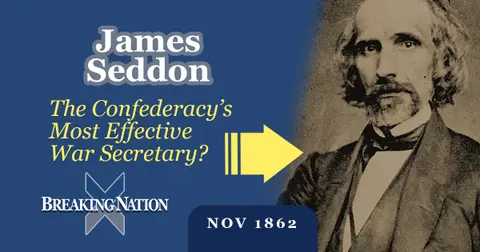
On November 21, 1862, Jefferson Davis appointed James Alexander Seddon of Virginia as Confederate Secretary of War, replacing George W. Randolph, who had resigned after a contentious relationship with the president. The appointment marked an important moment in the Confederate government's continuing struggle to manage the enormous administrative demands of a prolonged war. Seddon would prove to be one of Davis's most capable cabinet members and, importantly, the longest-serving Confederate secretary of war during the conflict.
Seddon was not a military professional. Born in Virginia in 1815, he was a lawyer by training and a former Democratic congressman who had served two terms in the United States House of Representatives. He had also participated in the 1861 Washington Peace Conference before embracing secession and joining the Confederate government. His political experience, legal education, and familiarity with national government made him a considerably more substantial appointment than some of Davis's earlier choices.
The Confederate War Department had experienced considerable instability. Its first secretary, Leroy Pope Walker, proved an inadequate administrator, struggling to manage the department's growing responsibilities. Judah P. Benjamin, who succeeded Walker, was intellectually gifted and politically influential but was overwhelmed by the department's demands. His tenure became increasingly controversial, particularly following Confederate military setbacks and the loss of Roanoke Island. George Randolph, a former artillery officer, brought military knowledge and administrative discipline to the position. He improved procurement, strengthened coastal defenses, and helped establish conscription. However, his increasingly strained relationship with Davis, particularly over military authority and the disposition of troops, ultimately drove him from office.
Seddon offered a different combination of strengths. He was politically astute, administratively capable, and, perhaps most importantly, willing to work within Davis's increasingly centralized system of command. Unlike Randolph, he did not openly challenge the president's authority. Davis maintained unusually close supervision of the War Department, and Seddon generally accepted that arrangement. His relationship with Robert E. Lee also became particularly important. The two men developed a close working relationship, making Seddon one of Davis's most trusted military and political advisers.
That does not mean Seddon was without shortcomings. His deference to Davis sometimes limited his independence, and he could not overcome the Confederacy's increasingly desperate shortages of manpower, supplies, transportation, and industrial capacity. Nevertheless, he generally understood the war's larger strategic requirements and supported efforts to strengthen Confederate operations in the Western Theater.
Seddon's appointment brought something the Confederate War Department desperately needed: continuity. He remained in office until January 1865, considerably longer than his predecessors. He was not a miracle worker, but he was arguably the most consistently effective administrator to hold the position. His tenure demonstrated that capable leadership could improve Confederate military administration, even when the underlying resources necessary to win the war were steadily disappearing.
Breaking Nation: A Civil War Podcast explores the American Civil War, its turning points, and our national memory. Discover full episodes, transcripts, and resources at www.breakingnation.com — your destination for in-depth Civil War podcast content and fresh perspectives on America’s past. Listen on Apple Podcasts, Spotify and Amazon Music.
Why Antietam Wasn't Enough to Save McClellan