The Seven Days’ Most Uneven Fight: Malvern Hill Explained
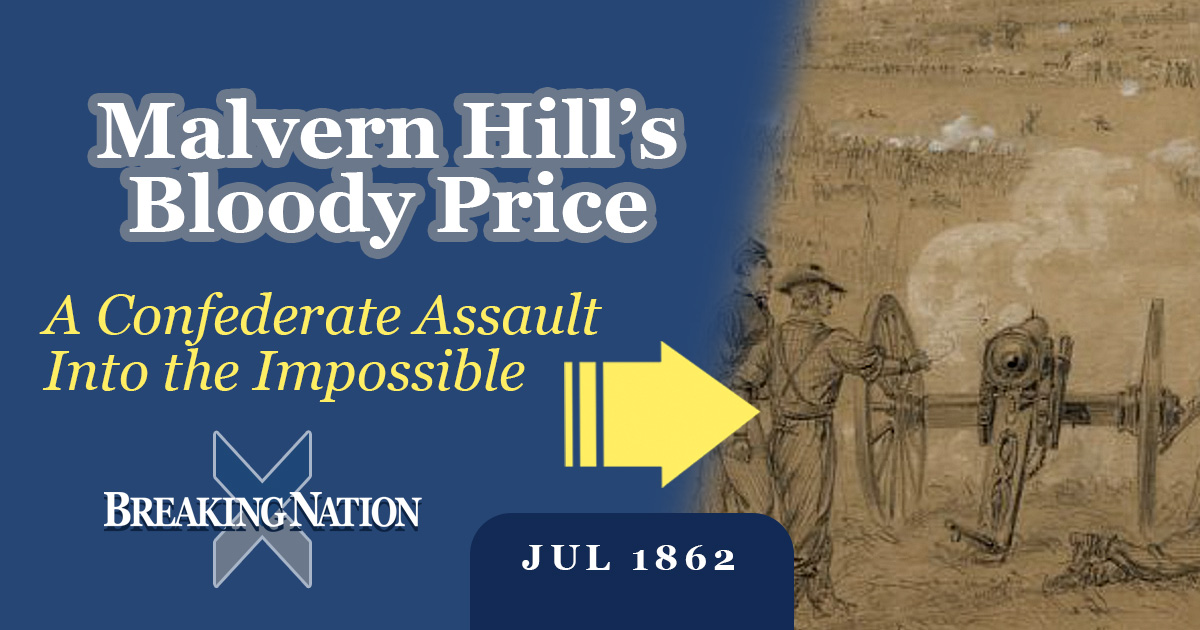
The Battle of Malvern Hill, fought on July 1, 1862, remains one of the clearest examples of the difference between strategic success and tactical competence in the Civil War. While Confederate General Robert E. Lee is rightly celebrated for saving Richmond during the Seven Days Campaign, Malvern Hill stands as a sobering reminder that even great commanders can make costly mistakes. In fact, the battle raises serious questions about Lee's battlefield judgment and his willingness to expend manpower in pursuit of uncertain objectives.
By the time the armies reached Malvern Hill, George B. McClellan's Army of the Potomac was retreating toward the James River. Yet the Federal army was hardly defeated. On the elevated plateau of Malvern Hill, Union commanders occupied one of the strongest defensive positions of the war. The terrain offered open fields of fire, protected flanks, and excellent artillery positions. More than 250 Union guns covered the approaches, creating a killing ground for any attacking force.
Lee recognized that McClellan was withdrawing and believed one final blow might destroy the Army of the Potomac. The problem was that the battlefield offered almost no realistic opportunity for such a victory. Confederate commanders struggled to identify the enemy's exact position, communication broke down repeatedly, and Lee's attack plan depended on a coordinated artillery bombardment that never materialized. Despite these warning signs, Confederate assaults went forward.
The results were disastrous. Confederate brigades advanced in fragmented attacks against a well-prepared enemy and were shattered by concentrated artillery and infantry fire. Southern troops displayed tremendous courage, but courage could not overcome mathematics. Wave after wave was thrown against a position that should have been recognized as nearly impregnable. Confederate casualties exceeded 5,000 men, while Union losses were less than half that number.
Malvern Hill is significant because it exposed a recurring feature of Lee's command style: a preference for aggressive offensive action even when battlefield conditions strongly favored the defense. Historians often focus on Lee's audacity and willingness to seize the initiative, but Malvern Hill demonstrates the risks of that approach. The battle foreshadowed later Confederate disasters at places such as Fredericksburg and Gettysburg, where costly frontal assaults produced devastating losses.
Ironically, Lee emerged from the Seven Days Campaign as a hero. McClellan abandoned his advance on Richmond, giving the Confederacy a strategic victory despite the defeat at Malvern Hill. Yet the battle itself remains one of the strongest pieces of evidence that Lee's reputation as a battlefield tactician deserves careful scrutiny. At Malvern Hill, Confederate bravery could not compensate for flawed leadership, and thousands of soldiers paid the price.
Breaking Nation: A Civil War Podcast explores the American Civil War, its turning points, and our national memory. Discover full episodes, transcripts, and resources at www.breakingnation.com — your destination for in-depth Civil War podcast content and fresh perspectives on America’s past. Listen on Apple Podcasts, Spotify and Amazon Music.

The Battle of Iuka: Grant’s Battle That Almost Failed