The Battle That Changed Two Lives: Lee and Clara Barton
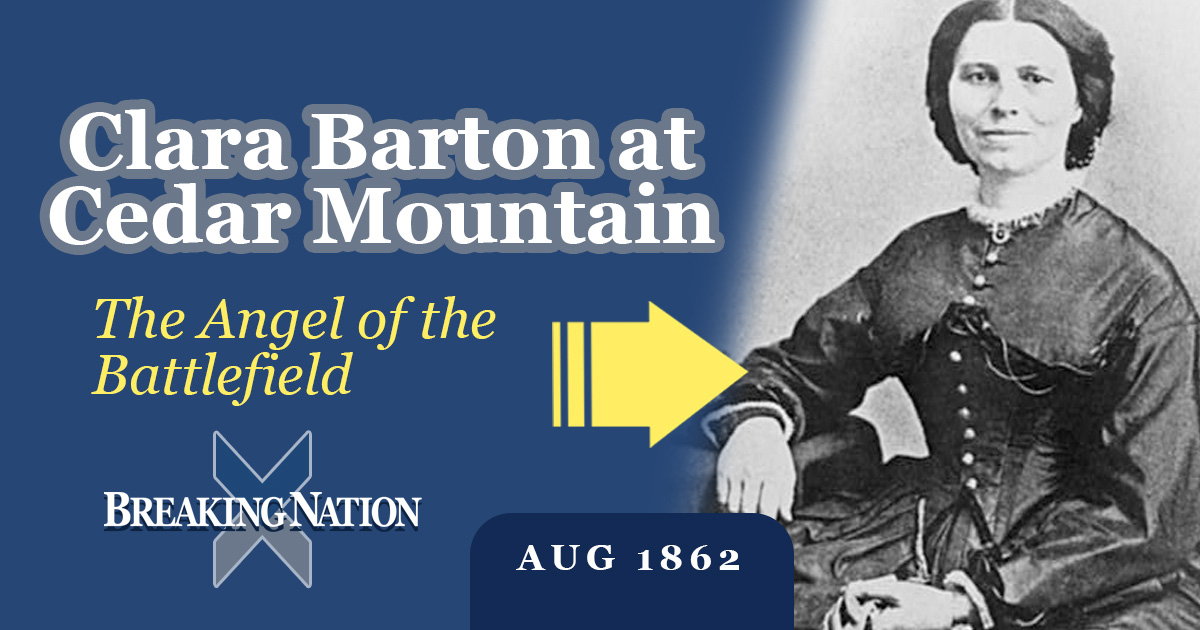
The Battle of Cedar Mountain, fought on August 9, 1862, is often remembered as the opening engagement of Robert E. Lee's Northern Virginia Campaign, but its significance extends well beyond military strategy. While the Confederate victory helped set the stage for the crushing Union defeat at Second Bull Run later that month, the battle also marked a quieter but equally enduring milestone in American history: it was the first battlefield where Clara Barton personally ministered to wounded soldiers. In many respects, Cedar Mountain helped shape both the course of the war and the future of military medicine.
Following George B. McClellan's withdrawal from the Virginia Peninsula, Lee turned his attention to the newly created Union Army of Virginia under Major General John Pope. Hoping to defeat Pope before he could unite with McClellan, Lee sent Thomas "Stonewall" Jackson with roughly 24,000 men to confront the Union advance near Culpeper Court House.
The battle quickly became one of the fiercest clashes of the summer of 1862. Union Major General Nathaniel Banks, eager to redeem himself after earlier defeats in the Shenandoah Valley, launched a bold attack before Jackson's entire force had assembled. Banks's men initially drove the Confederates back and came dangerously close to breaking Jackson's line. Jackson himself reportedly attempted to draw his sword to rally retreating troops, only to find it rusted in its scabbard. Forced to wave the sheathed sword instead, he steadied his soldiers until reinforcements arrived to reverse the tide.
Although Confederate casualties approached 1,300 and Union losses exceeded 2,300, the importance of Cedar Mountain cannot be measured by numbers alone. Lee's victory confirmed that he intended to seize the strategic initiative in Virginia. It exposed the organizational weaknesses of Pope's newly assembled army and gave Lee the confidence to continue his offensive, culminating in the decisive Confederate victory at Second Bull Run only weeks later.
Yet one of the battle's most lasting legacies unfolded after the shooting stopped. Clara Barton, then a government clerk who had spent months collecting and distributing supplies to Union troops, traveled to Cedar Mountain with wagonloads of bandages, food, lanterns, and medical necessities. Arriving shortly after the fighting ended, she found overwhelmed surgeons struggling to care for hundreds of wounded men lying in fields and makeshift hospitals. Rather than simply deliver supplies, Barton rolled up her sleeves and joined the work, dressing wounds, comforting soldiers, preparing food, and helping exhausted medical personnel through the night.
The experience transformed her understanding of wartime relief. Barton recognized that supplies were of little value unless someone ensured they reached the wounded when and where they were needed most. Cedar Mountain became the beginning of her career as a frontline humanitarian. Over the next three years she would repeatedly place herself in danger to aid soldiers at battles such as Antietam, Fredericksburg, and Petersburg, eventually earning the enduring title "Angel of the Battlefield." Her wartime experiences would later inspire her efforts to found the American Red Cross in 1881, permanently changing disaster relief and humanitarian aid in the United States.
Cedar Mountain therefore deserves recognition not only as the battle that launched Lee's successful campaign against Pope, but also as the place where one woman's extraordinary commitment to caring for the wounded began to reshape the human side of warfare. While generals measured victory in captured ground and broken armies, Clara Barton measured it in lives saved—a legacy that has outlasted the battlefield itself.
Breaking Nation: A Civil War Podcast explores the American Civil War, its turning points, and our national memory. Discover full episodes, transcripts, and resources at www.breakingnation.com — your destination for in-depth Civil War podcast content and fresh perspectives on America’s past. Listen on Apple Podcasts, Spotify and Amazon Music.
The Battle of Iuka: Grant’s Battle That Almost Failed