The Battle That Ended the CSS Arkansas's Remarkable Run
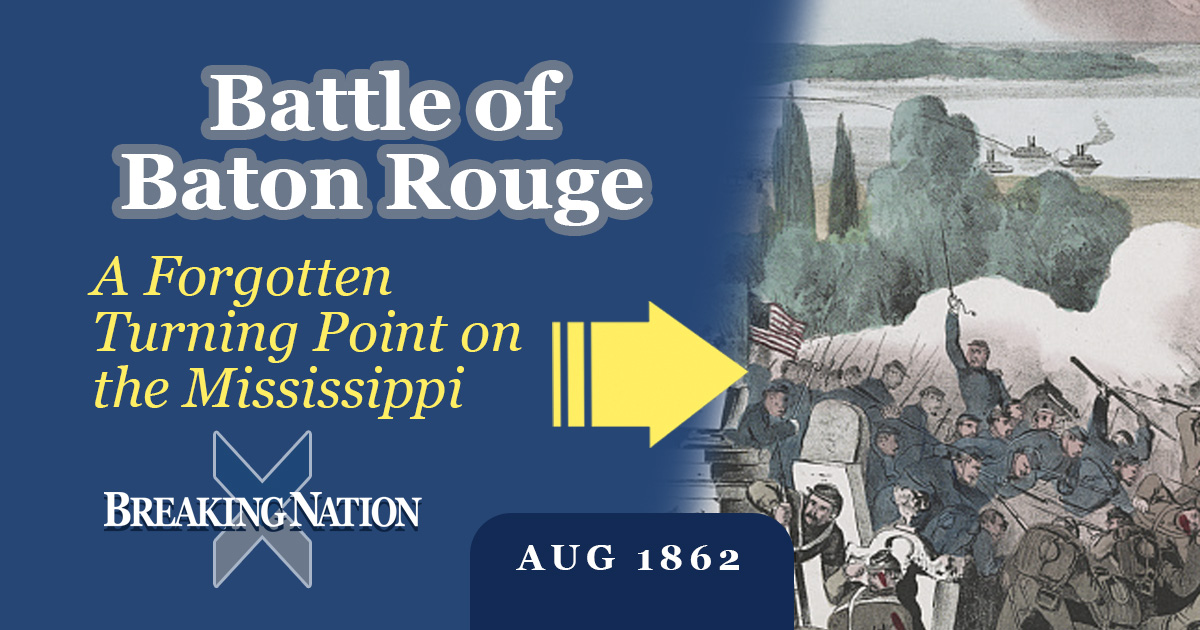
The fighting at Baton Rouge on August 5, 1862, and the destruction of the Confederate ironclad CSS Arkansas the following day marked the collapse of one of the Confederacy's last serious attempts to challenge Union control of the lower Mississippi River. Although neither event receives the attention given to Shiloh, Antietam, or Vicksburg, together they underscored the widening gap between Confederate ambition and its shrinking ability to sustain offensive operations in the West.
After the Union captured New Orleans in the spring of 1862, Confederate leaders hoped to regain momentum by striking the Federal garrison at Baton Rouge. Major General John C. Breckinridge led roughly 3,000 Confederate troops against a similarly sized Union force commanded by Brigadier General Thomas Williams. The Confederates initially made progress, driving Union troops back through portions of the city. However, the attack depended heavily on support from the ironclad CSS Arkansas, whose powerful guns were expected to neutralize Union naval forces on the Mississippi.
That support never materialized. The Arkansas, already plagued by chronic mechanical problems after its daring run through the Union fleet at Vicksburg in July, suffered repeated engine failures while steaming toward Baton Rouge. Unable to reach the battlefield and with Union warships approaching, her crew deliberately ran the vessel aground on August 6 before setting her ablaze and detonating her magazine to prevent capture.
The loss of the Arkansas was far more consequential than the tactical outcome at Baton Rouge itself. For several weeks, the ironclad had demonstrated that a single well-armored warship could threaten even superior Union naval forces. Her destruction eliminated the Confederacy's most effective naval weapon on the Mississippi at a time when Southern shipbuilding capacity and industrial resources were already stretched to the breaking point. Replacing such a vessel was virtually impossible.
The failed attack also revealed the growing difficulty of coordinating Confederate army and navy operations. Poor communications, unreliable transportation, and mechanical failures repeatedly undermined otherwise promising plans. Baton Rouge became another example of how the Confederacy's logistical weaknesses often proved more damaging than Union battlefield success.
Strategically, the battle helped solidify Union control of Baton Rouge and strengthened the Federal position along the lower Mississippi. With the Arkansas gone, Union gunboats operated with greater freedom, tightening the noose around Confederate strongholds farther upriver. One year before the fall of Vicksburg permanently divided the Confederacy, the events of August 5-6, 1862, demonstrated that Confederate hopes of reversing Union dominance on the Mississippi were rapidly slipping away.
Breaking Nation: A Civil War Podcast explores the American Civil War, its turning points, and our national memory. Discover full episodes, transcripts, and resources at www.breakingnation.com — your destination for in-depth Civil War podcast content and fresh perspectives on America’s past. Listen on Apple Podcasts, Spotify and Amazon Music.
The Bloodiest Day: What Really Happened at Antietam