Lincoln’s Order That Put McClernand on a Collision Course with Grant
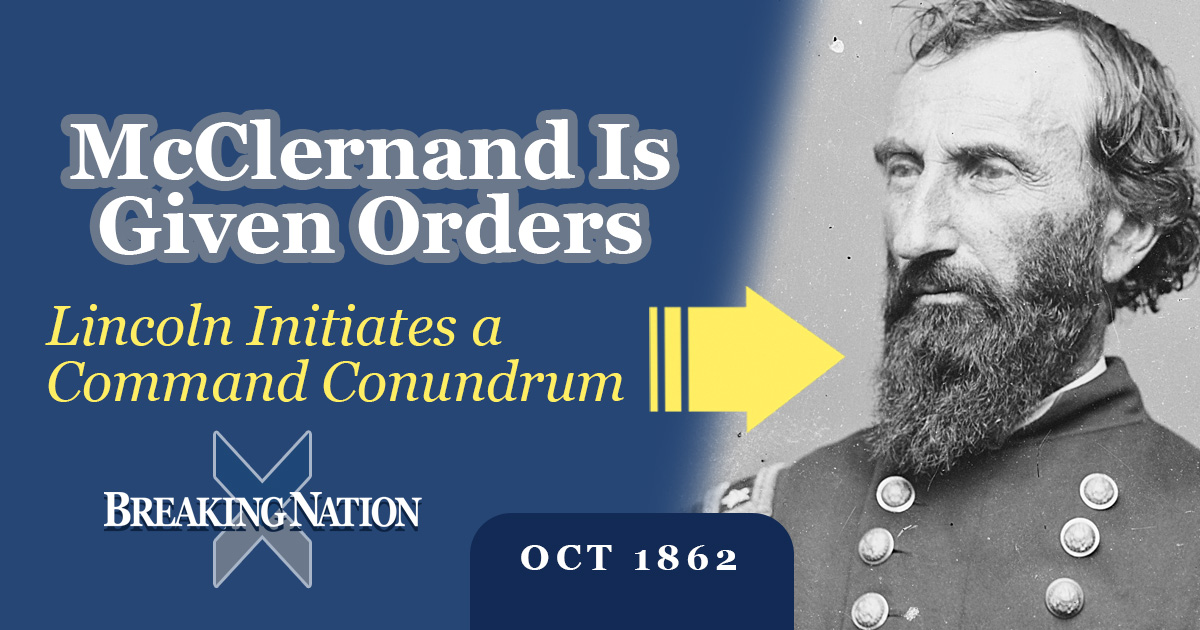
On October 20, 1862, President Abraham Lincoln took a step that seemed straightforward on paper but would have important consequences for the Union war effort in the West. He authorized Major General John A. McClernand to organize troops in Indiana, Illinois, and Iowa for an expedition against Vicksburg, Mississippi. The objective was nothing less than clearing the Mississippi River and reopening navigation to New Orleans.
Vicksburg was already emerging as one of the Confederacy’s most important strongholds. Sitting high above the Mississippi, it blocked Union control of the river and prevented the North from fully severing the Confederacy. McClernand understood its importance—and saw an opportunity. A former Democratic congressman from Illinois, he had political connections and considerable ambition. In September, he had written Lincoln proposing an enormous expedition to seize Vicksburg, arguing that reopening the Mississippi would cripple the Confederate war effort.
Lincoln liked the idea, but the problem was command.
Vicksburg was already within the broad area of operations of Ulysses S. Grant. Grant was developing his own plans against the city, attempting to move south through Mississippi. Yet Lincoln and Secretary of War Edwin Stanton were effectively creating another command structure around McClernand without first coordinating the matter with Grant or Major General Henry Halleck, the Union general-in-chief. The order itself contained an important limitation: McClernand's troops would remain subject to the general-in-chief and could be used according to military necessity.
But McClernand interpreted the arrangement differently. He believed he was being given the opportunity to raise an army that would ultimately operate under his own command against Vicksburg. For Grant, this was an awkward—and potentially dangerous—development. He was already responsible for operations in the region, and now a politically connected general appeared to be building an independent army aimed at the same strategic objective.
The result was friction that would only intensify.
Grant responded by moving aggressively to get his own Vicksburg campaign underway before McClernand could arrive with his new force. McClernand, meanwhile, continued to believe that Lincoln's authorization entitled him to an independent command. The dispute eventually produced a compromise: McClernand's troops would become part of Grant's army, while McClernand would receive command of a corps. Neither man was particularly satisfied.
The irony is that Lincoln's order ultimately helped create the very command relationship that would make the Vicksburg campaign so contentious. McClernand would become one of Grant's most persistent critics, challenging his authority and later openly disputing his decisions.
Thus, October 20 was significant not simply because Lincoln authorized another expedition against Vicksburg. He set in motion a rivalry between two very different kinds of Union general: the politically ambitious McClernand and the increasingly dominant professional soldier, Ulysses S. Grant. Their conflict would follow the Union army all the way to Vicksburg—and beyond.
Breaking Nation: A Civil War Podcast explores the American Civil War, its turning points, and our national memory. Discover full episodes, transcripts, and resources at www.breakingnation.com — your destination for in-depth Civil War podcast content and fresh perspectives on America’s past. Listen on Apple Podcasts, Spotify and Amazon Music.
Season 2 Episode 2 – Summer of War