How the Confederacy Lost Kentucky at Perryville
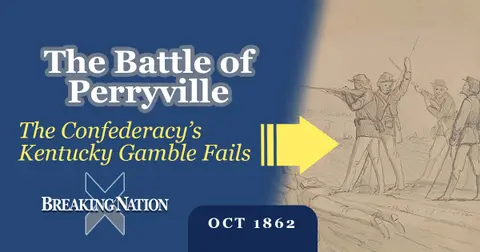
The Battle of Perryville, fought on October 8, 1862, was one of the most important—and often overlooked—battles of the American Civil War. Although it produced no dramatic battlefield collapse and ended without a clear tactical victory, Perryville effectively ended the Confederate invasion of Kentucky and helped secure the state for the Union. Its significance reached far beyond the fields and hills where the fighting took place.
By the autumn of 1862, Confederate leaders hoped that an invasion of Kentucky might accomplish several things at once: recruit soldiers, strengthen Confederate control of the border state, threaten Union positions in the West, and perhaps encourage Kentucky to embrace the Southern cause. Confederate General Braxton Bragg moved into Kentucky with the Army of Mississippi, while Edmund Kirby Smith operated farther east. At first, the campaign appeared promising. But the expected wave of Confederate recruits never materialized, and Union forces under Don Carlos Buell moved to challenge Bragg.
The armies finally collided at Perryville, a small community in central Kentucky. The battle itself was brutal. Confederate forces, attacking piecemeal, repeatedly drove back portions of the Union army. The fighting was particularly intense on the Union left, where Confederate troops pushed deep into Federal positions. Yet the Confederates were unable to destroy Buell's army or force it from the field.
The strange irony of Perryville is that the Union army technically lost the tactical fight but won the larger campaign. Buell's forces suffered roughly 4,200 casualties, compared with approximately 3,400 Confederate casualties. But Bragg's army had failed to accomplish its strategic objectives. With Union reinforcements arriving and his own position becoming increasingly difficult to sustain, Bragg withdrew from Kentucky.
That withdrawal was the real meaning of Perryville. The Confederacy had made a major attempt to seize Kentucky, and it had failed. From this point forward, Confederate armies would struggle to establish a permanent foothold in the state. Kentucky's strategic importance was enormous: it bordered the Ohio River, controlled important transportation routes, and occupied a critical position between the Western and Eastern theaters.
Perryville also exposed serious problems in Union command. Buell's army had been fighting a major battle largely without its commander understanding what was happening in real time. Communication failures meant that Buell did not initially realize the scale of the engagement. The episode contributed to the growing doubts about his leadership and helped set the stage for his eventual removal.
Perryville therefore stands as a reminder that Civil War battles cannot be judged simply by who held the field at sunset. Tactically, the Confederates had achieved considerable success. Strategically, however, they had failed. Kentucky remained in Union hands, Bragg's invasion had collapsed, and the Confederacy had lost one of its best opportunities to alter the balance of power in the Western Theater.
Perryville was not the war's most famous battle. But in the fall of 1862, it quietly helped determine where the war would—and would not—be fought.
Breaking Nation: A Civil War Podcast explores the American Civil War, its turning points, and our national memory. Discover full episodes, transcripts, and resources at www.breakingnation.com — your destination for in-depth Civil War podcast content and fresh perspectives on America’s past. Listen on Apple Podcasts, Spotify and Amazon Music.
Why Corinth Mattered More Than You Think