The Day Black Soldiers Officially Joined the Union Army
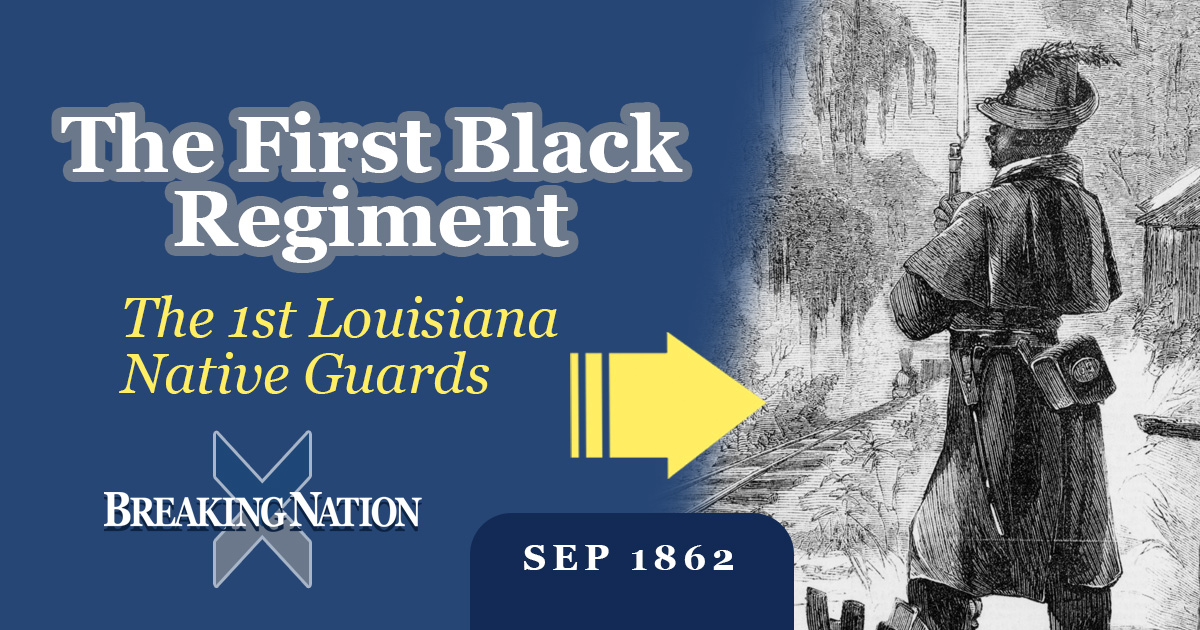
On September 27, 1862, something happened in New Orleans that would prove far more important than it may have seemed at the time: the 1st Regiment Louisiana Native Guards was formally mustered into Union service. It was the first Black regiment officially accepted into the United States Army, marking a significant turning point in the Civil War and in the nation’s understanding of who could fight for the Union.
The story actually began a month earlier. On August 22, Major General Benjamin Butler, commanding Union forces occupying New Orleans, issued General Order No. 63. Butler authorized the enlistment of the city’s free men of color, specifically recognizing the existing Native Guards militia and inviting its members—and other free Black citizens—to volunteer for United States service. Butler praised their “well-known loyalty and patriotism” and ordered that those who enlisted be armed, equipped, paid, and treated as other volunteer soldiers, subject to presidential approval.
Butler’s decision was partly ideological, but it was also intensely practical. His army was stretched thin, Confederate resistance remained a threat, and the possibility of an attack on Union-held Louisiana forced him to reconsider the military potential of Black New Orleanians. In August, Butler told Secretary of War Edwin Stanton that he was prepared to “call on Africa” for assistance.
There was another important wrinkle. Butler had initially been reluctant to arm Black men. Earlier that summer, he had opposed General John W. Phelps’s attempt to organize Black soldiers. But circumstances—and federal policy—were changing rapidly. Congress had passed the Militia Act of July 1862, authorizing the president to employ men of African descent in military service. Butler now had both a military reason and a legal opening to move forward.
The regiment that emerged was not simply a continuation of the old antebellum Native Guard. Although some veterans of the earlier organization joined, most of the new recruits were Black men who had escaped slavery or otherwise found themselves in Union-held New Orleans. Roughly 1,000 men eventually filled the regiment.
Its significance therefore went well beyond one regiment in one occupied city. The September 27 muster demonstrated that Black men could be organized, trained, armed, and placed into the Union military establishment. It also helped establish a precedent that would soon expand dramatically. Within months, additional Louisiana Native Guard regiments were formed, and eventually nearly 180,000 Black men would serve in the Union armies.
The 1st Louisiana Native Guards did not win the war by themselves. But its existence helped change the nature of the war. What had begun largely as a conflict to preserve the Union was increasingly becoming a war in which African Americans themselves would fight for their freedom—and for the destruction of slavery.
Breaking Nation: A Civil War Podcast explores the American Civil War, its turning points, and our national memory. Discover full episodes, transcripts, and resources at www.breakingnation.com — your destination for in-depth Civil War podcast content and fresh perspectives on America’s past. Listen on Apple Podcasts, Spotify and Amazon Music.
The Battle of Iuka: Grant’s Battle That Almost Failed