Season 2 Episode 2 – Summer of War
They thought it would be over quickly.
In the summer of 1861, Americans on both sides of the growing Civil War still carried remarkably romantic ideas about what was coming. Soldiers marched off with enthusiasm. Politicians talked confidently about victory. And when the armies finally collided at Bull Run, some civilians from Washington actually packed picnic lunches and traveled to watch the battle.
Then the shooting started.
What followed was a summer that shattered illusions.
In this episode of Breaking Nation, we enter those extraordinary months when Americans began discovering that war was not a glorious spectacle to be observed from a safe distance. It was confusion, fear, bloodshed—and casualty lists filled with the names of friends, neighbors, and loved ones.
Bull Run was the largest battle yet fought on the North American continent. But it wasn't the only shock. Thousands of miles away, the Battle of Wilson's Creek in Missouri produced another concentrated burst of violence and another sobering reminder that the conflict was spreading across an enormous nation.
And the battles were only the beginning.
How did inexperienced armies perform when suddenly thrown into massive battles? Could commanders actually control tens of thousands of men without the communications technology we take for granted? What happened when ambitious battlefield plans depended on two separate columns arriving at exactly the right moment? At Wilson's Creek, Lyon and Sigel attempted precisely that—and, remarkably, their pincer movement initially worked.
But the summer also forced America to confront questions far more profound than battlefield tactics.
What was this war really about?
The Lincoln administration insisted that preserving the Union was the central objective. Yet the question of slavery refused to stay on the sidelines. Ben Butler's decision to classify escaped enslaved people as "contraband" raised questions the government could no longer easily avoid. Congress responded with the Confiscation Act. Then John C. Frémont went even further, declaring enslaved people in his military department free. Suddenly, the meaning and purpose of the war were becoming matters of urgent national debate.
And as battlefield failures accumulated, another question emerged: Who was actually capable of winning this war?
Congress created the Joint Committee on the Conduct of the War, reflecting growing concern about military leadership and battlefield performance. Meanwhile, both governments were discovering that the armies they had raised would have to become vastly larger than anyone initially imagined.
The summer of 1861 was therefore much more than the opening chapter of the Civil War.
It was the moment America began to understand what it had gotten itself into.
The summer was ending. The illusions were ending with it.
Breaking Nation: A Civil War Podcast explores the American Civil War, its turning points, and our national memory. Discover full episodes, transcripts, and resources at www.breakingnation.com — your destination for in-depth Civil War podcast content and fresh perspectives on America’s past. Listen on Apple Podcasts, Spotify and Amazon Music.
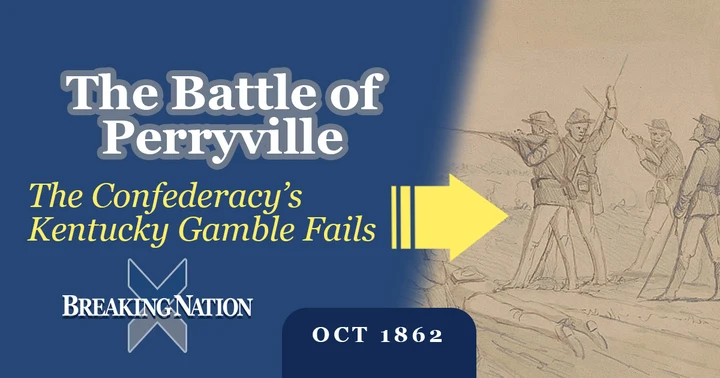
How the Confederacy Lost Kentucky at Perryville