The Second Confiscation Act: The Forgotten Step Toward Emancipation
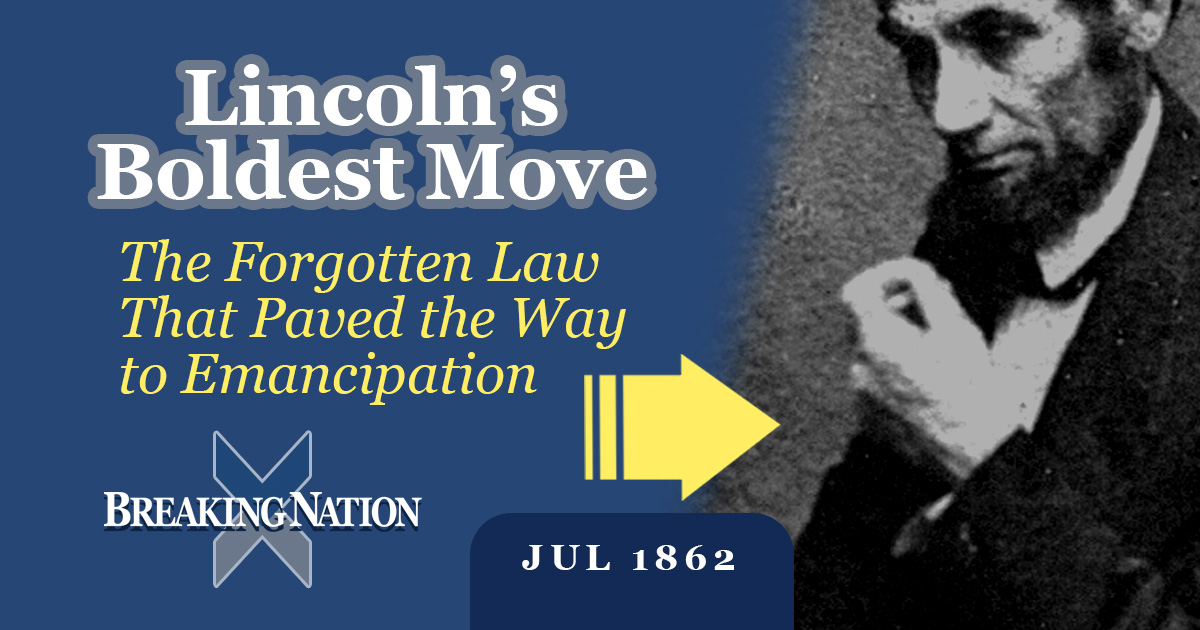
The Second Confiscation Act, signed by Abraham Lincoln on July 17, 1862, marked a turning point in the Union's conduct of the Civil War. Although the conflict had begun primarily as an effort to preserve the Union rather than abolish slavery, the legislation reflected a growing recognition that slavery was inseparable from the Confederacy's ability to wage war. By authorizing the seizure of property used to support the rebellion—including enslaved people—it transformed emancipation from an incidental consequence of military operations into an explicit instrument of federal policy.
The act expanded upon the weaker First Confiscation Act of 1861. That earlier law permitted the confiscation of enslaved people who had been directly employed in support of Confederate military efforts. The Second Confiscation Act went much further. It declared that enslaved persons belonging to individuals engaged in rebellion "shall be forever free" once they came under Union control. While enforcement varied and the law contained legal ambiguities, its significance lay in the principle it established: the federal government was now prepared to use its wartime powers to undermine slavery itself.
Equally important, the act imposed penalties on Confederate officials and supporters by authorizing the confiscation of their property. This represented a harder war policy, signaling that the rebellion would carry lasting legal and economic consequences. Congress was no longer content merely to suppress Confederate armies; it sought to dismantle the social and economic foundations that sustained them.
The timing of the legislation was also crucial. Lincoln signed it on the same day as the Militia Act of 1862, which authorized the employment of African Americans in military service. Together, these measures anticipated the broader transformation that would follow with the Preliminary Emancipation Proclamation just two months later, on September 22, 1862. In many respects, the Second Confiscation Act provided both legal and political groundwork for Lincoln's proclamation by demonstrating congressional support for emancipation as a wartime necessity.
Despite its importance, the act had practical limitations. It did not abolish slavery throughout the United States, nor could it immediately free millions still living deep within Confederate territory. Freedom generally depended upon the advance of Union armies. Nevertheless, the legislation fundamentally altered the character of the war. It affirmed that victory would require not only defeating Confederate soldiers but also destroying the institution of slavery that underpinned the Confederate economy, labor system, and political order.
Viewed in retrospect, the Second Confiscation Act stands as one of the most consequential pieces of Civil War legislation. It bridged the gap between a war fought solely for reunion and a war fought for both union and freedom, laying an essential foundation for emancipation and, ultimately, the Thirteenth Amendment.
Breaking Nation: A Civil War Podcast explores the American Civil War, its turning points, and our national memory. Discover full episodes, transcripts, and resources at www.breakingnation.com — your destination for in-depth Civil War podcast content and fresh perspectives on America’s past. Listen on Apple Podcasts, Spotify and Amazon Music.
Season 2 Episode 2 – Summer of War