The Federal Push for the South’s Largest Port: New Orleans 1862
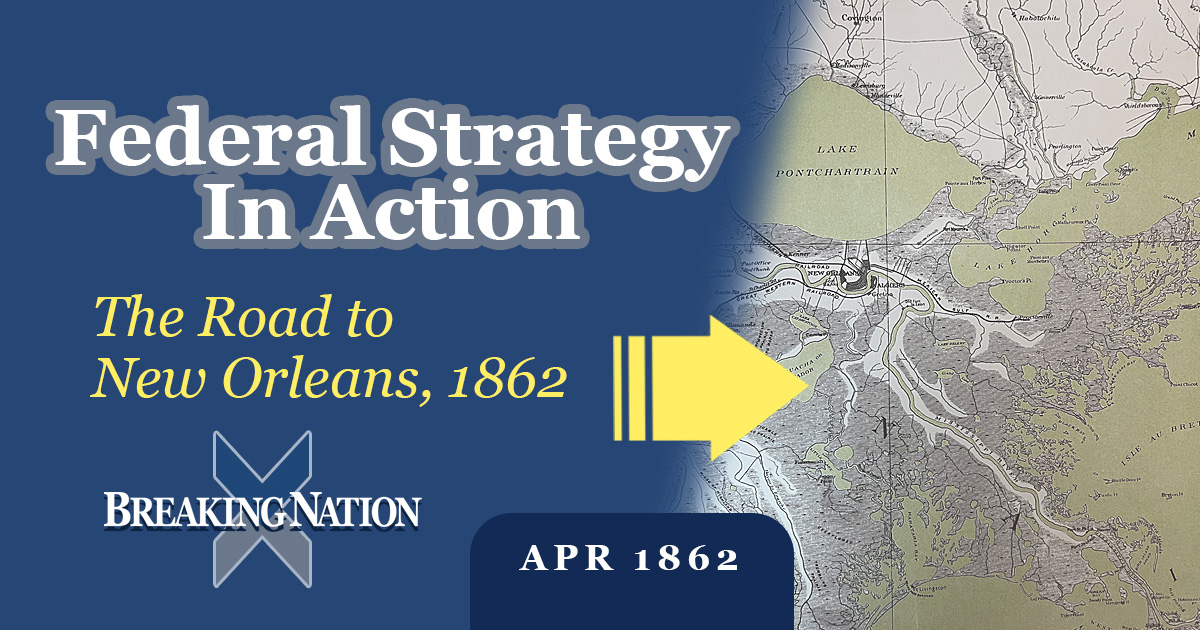
The Federal campaign against New Orleans in 1862 represented a crucial pivot in the Union’s strategy during the American Civil War, marking a decisive shift from purely defensive operations along the Mississippi River to a coordinated offensive aimed at severing the Confederacy’s economic and strategic lifelines. New Orleans, the largest city in the South and a vital port at the mouth of the Mississippi River, was not only a hub of commerce but also a symbolic anchor for Confederate identity. Its location made it the gateway to the interior of the South, controlling the river traffic that sustained both military logistics and the broader Southern economy. The Union recognized early on that dominance over New Orleans would strike a severe blow to Confederate cohesion, potentially accelerating the fracturing of Southern supply lines and undermining morale.
The campaign itself illustrated the evolution of Union military thinking under leaders such as Flag Officer David Farragut and Major General Benjamin Butler, whose coordination reflected the growing sophistication of combined naval and land operations. The Federal strategy leveraged naval firepower and maneuverability to impose a blockade and secure river access, thereby illustrating a broader trend in 1862 toward exploiting technological advantages—particularly steam-powered warships and rifled artillery—to compensate for manpower limitations. This approach underscored the Union’s recognition that controlling waterways was as critical as winning pitched battles on land, a principle that would shape subsequent campaigns throughout the war.
Moreover, the campaign against New Orleans highlighted the interconnectedness of military objectives with economic and political pressures. The Union’s focus on a major commercial center demonstrated a strategic logic rooted in disruption: by targeting the Confederacy’s capacity to export cotton and import war materiel, the North sought to leverage economic deprivation as a form of indirect warfare. At the same time, the campaign signaled the Union’s growing willingness to engage in operations that had direct psychological implications. New Orleans was not just a logistical prize; it was a cultural and political symbol whose control promised to shake Confederate confidence and potentially encourage loyalty shifts among Southern populations.
Finally, the Federal approach to New Orleans reflected an early instance of the Union’s increasingly integrated use of intelligence, reconnaissance, and technological innovation. The campaign required detailed knowledge of river currents, fortifications, and Confederate defensive strategies, forcing Union commanders to adapt continuously to environmental and tactical challenges. In doing so, the operation served as a template for subsequent campaigns along the Mississippi, demonstrating the Union’s capacity for coordinated, multi-domain warfare that combined naval dominance, strategic foresight, and operational flexibility.
This campaign, even before the city’s capture, thus exemplified the Union’s strategic maturation in 1862, highlighting the interplay of geography, technology, and economics in shaping the conduct of modern war.
Breaking Nation: A Civil War Podcast explores the American Civil War, its turning points, and our national memory. Discover full episodes, transcripts, and resources at www.breakingnation.com — your destination for in-depth Civil War podcast content and fresh perspectives on America’s past. Listen on Apple Podcasts, Spotify and Amazon Music.
Season 2 Episode 2 – Summer of War