The Battle of Iuka: Grant’s Battle That Almost Failed
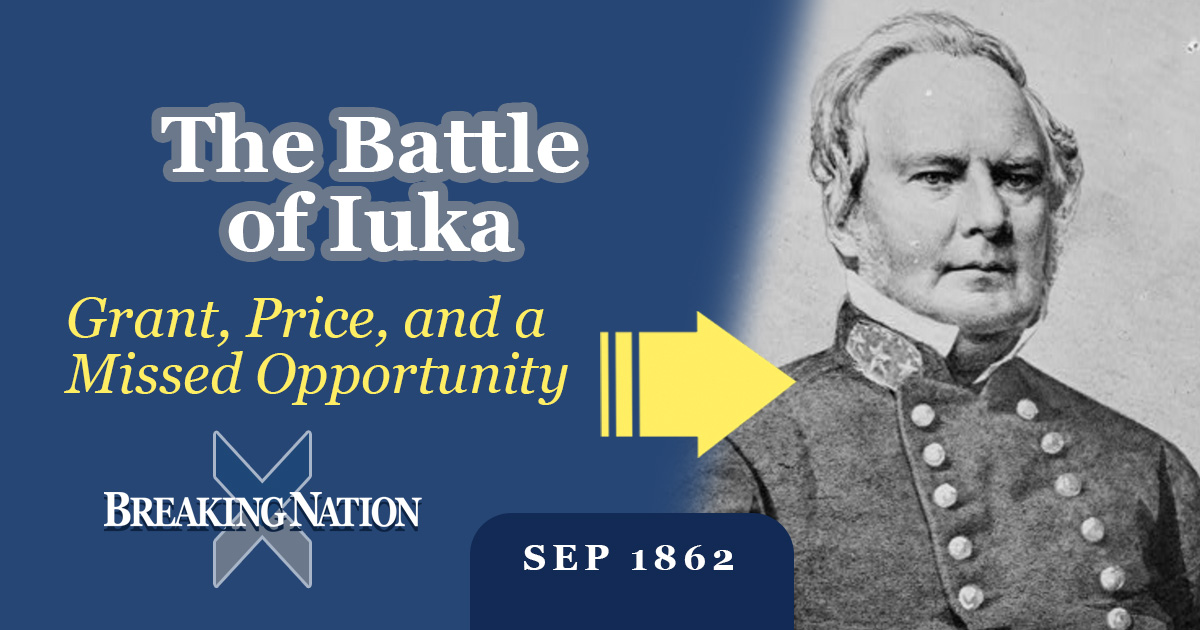
The Battle of Iuka, fought on September 19, 1862, was a relatively small engagement by Civil War standards, but its significance was considerably larger than its casualty figures might suggest. Fought in northern Mississippi, Iuka was part of Union efforts to secure the vital railroads and transportation routes that connected the Confederate heartland with the armies operating farther east. More importantly, it exposed both the opportunities and the frustrations that would characterize Union operations in the Western Theater during the fall of 1862.
The battle began when Confederate General Sterling Price occupied Iuka with roughly 3,000 men. Union General William S. Rosecrans moved against him with a force of about 9,000 soldiers, while Major General Ulysses S. Grant coordinated a second Union column under Edward Ord to block Price's escape. The basic plan was sound: trap Price between two converging Union forces and destroy his army.
But the execution was anything but perfect.
Rosecrans's troops attacked from the west on September 19 and encountered stiff Confederate resistance. Price's men fought aggressively, exploiting the rugged terrain around Iuka. Meanwhile, Ord's column never entered the battle. An unusual acoustic phenomenon—a so-called “acoustic shadow”—prevented Ord and Grant from hearing the fighting and contributed to the failure of the two Union forces to coordinate their attacks.
Rosecrans nevertheless succeeded in forcing Price to withdraw. During the night, Price slipped southward and escaped the trap, leaving the Union with possession of Iuka. The battle cost both sides roughly 1,500 casualties, a substantial percentage of the forces actually engaged.
The immediate result was therefore ambiguous. The Union had won the field, but Price's army had escaped largely intact. Yet Iuka became important because it was only the opening act of a larger campaign. Grant quickly turned his attention toward Corinth, Mississippi, where Price joined forces with Earl Van Dorn. Their combined army subsequently moved against Corinth in October, producing the Battle of Corinth.
Iuka also demonstrated an important feature of Civil War command: having superior numbers meant little if those forces could not be coordinated effectively. Grant's plan depended on timing and cooperation between separate columns, but geography, communications, and battlefield conditions undermined the operation. The episode foreshadowed problems that would repeatedly plague Civil War armies.
Strategically, however, Iuka was another step in the Union's effort to maintain control of western Tennessee and northern Mississippi. After the Union victories at Forts Henry and Donelson and the capture of Corinth earlier in 1862, Confederate forces were struggling to regain the initiative in the region.
Iuka showed that they could still fight—and fight hard—but it also demonstrated the difficulty of reversing the Union's growing strategic advantage in the West. For Grant, the battle was frustrating but instructive. Within weeks, the campaign around Corinth would produce an even larger and more consequential confrontation, and Grant's Western command would emerge stronger from the experience.
Breaking Nation: A Civil War Podcast explores the American Civil War, its turning points, and our national memory. Discover full episodes, transcripts, and resources at www.breakingnation.com — your destination for in-depth Civil War podcast content and fresh perspectives on America’s past. Listen on Apple Podcasts, Spotify and Amazon Music.

The Bloodiest Day: What Really Happened at Antietam