Second Bull Run: The Battle That Exposed Lincoln's Greatest Problem
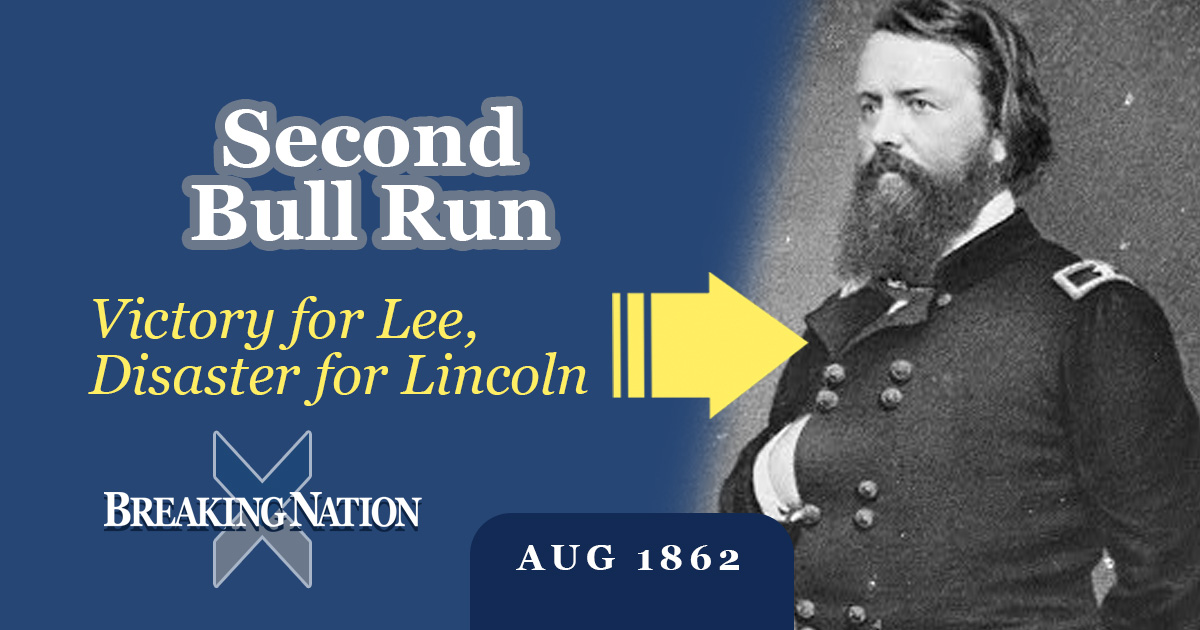
The Second Battle of Bull Run (or Second Manassas), fought between August 28 and 30, 1862, was one of the Confederacy's greatest battlefield victories, but it was also a devastating reminder of a deeper problem plaguing the Union war effort: President Abraham Lincoln was still searching for generals capable of translating the North's overwhelming advantages into military success. By the end of the campaign, nearly every senior Union commander involved had contributed to a pattern of confusion, rivalry, or outright incompetence that repeatedly frustrated Lincoln's strategy.
The campaign began brilliantly for Confederate General Robert E. Lee. After forcing George B. McClellan away from Richmond during the Seven Days Battles, Lee seized the initiative by moving north against Major General John Pope's newly formed Army of Virginia. Lee divided his army—a dangerous gamble—and sent Thomas "Stonewall" Jackson on a daring march around Pope's flank to destroy Union supplies at Manassas Junction. James Longstreet soon followed with the remainder of the Confederate army, setting the stage for one of the war's decisive battles.
The Confederates certainly fought skillfully, but Union failures made their task far easier. Pope consistently misread Confederate movements and convinced himself that Jackson was retreating when he was actually waiting for reinforcements. On August 30, Pope launched repeated assaults against Jackson's strong defensive position without realizing Longstreet's entire wing had arrived on the Confederate right. Longstreet's massive counterattack crushed the Union left flank and sent Pope's army retreating toward Washington.
Yet Pope was hardly the only problem. Lincoln also had to contend with George B. McClellan, whose relationship with Pope was strained from the outset. McClellan never concealed his contempt for Pope and moved slowly in reinforcing him after the Army of the Potomac returned from the Virginia Peninsula. Historians continue to debate whether McClellan's delays were merely cautious or reflected his personal dislike of Pope, but the result was the same: Pope entered battle without the full strength Lincoln expected.
The dysfunction extended even further. Corps commanders frequently misunderstood or ignored orders. Fitz John Porter, one of McClellan's trusted subordinates, refused to launch an attack on August 29 because he believed Longstreet's forces blocked his advance—a judgment later vindicated by many historians but interpreted at the time as disobedience. The controversy consumed the Army of the Potomac for years and highlighted the poisonous atmosphere among Union generals. Personal loyalties often outweighed unified command.
For Lincoln, Second Bull Run reinforced a painful lesson. The Union possessed greater manpower, industry, railroads, and financial resources than the Confederacy, but those advantages meant little without effective leadership. Since First Bull Run in 1861, Lincoln had watched promising campaigns dissolve because of hesitation, poor communication, inflated egos, or commanders who simply could not work together. The defeat at Second Bull Run was not merely another lost battle—it was evidence of a systemic leadership crisis.
Ironically, the disaster also opened the door to the next major chapter of the war. Emboldened by his victory, Lee crossed the Potomac into Maryland, beginning the campaign that culminated at Antietam. Meanwhile, Lincoln reluctantly turned once again to McClellan to rebuild the battered army, illustrating just how few commanders he believed were capable of organizing a major field force. Only with the later rise of leaders such as Ulysses S. Grant, William T. Sherman, Philip Sheridan, and George Thomas would Lincoln finally find generals whose determination matched the Union's vast potential.
Breaking Nation: A Civil War Podcast explores the American Civil War, its turning points, and our national memory. Discover full episodes, transcripts, and resources at www.breakingnation.com — your destination for in-depth Civil War podcast content and fresh perspectives on America’s past. Listen on Apple Podcasts, Spotify and Amazon Music.
Why Corinth Mattered More Than You Think