Lincoln’s July 1862 Gamble: Putting Halleck in Command
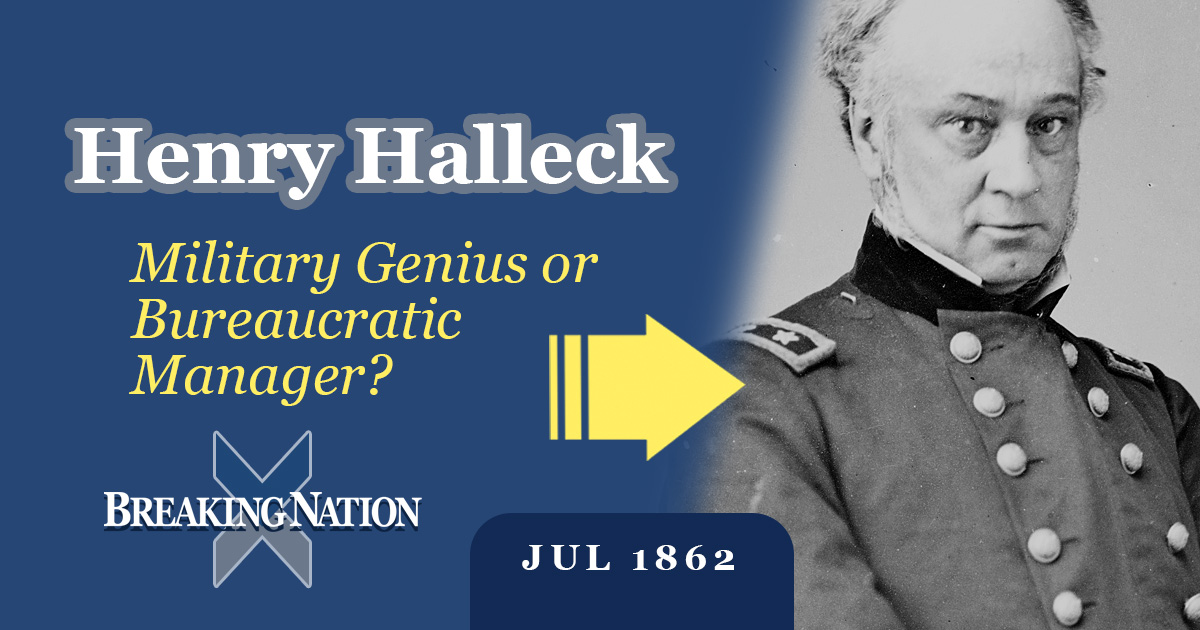
The appointment of Henry Wager Halleck as General-in-Chief of all Union armies on July 11, 1862, marked a significant turning point in the Union war effort. While Halleck himself is often overshadowed by more dynamic military figures such as Ulysses S. Grant, William T. Sherman, and George B. McClellan, his elevation reflected President Abraham Lincoln’s growing recognition that the Union needed a stronger system of centralized military coordination if it hoped to win the Civil War.
The appointment came at a moment of considerable frustration. Major General George B. McClellan’s Peninsula Campaign had stalled outside Richmond, and the Army of the Potomac had just retreated following the Seven Days Battles. Meanwhile, Union forces operating in different theaters often pursued disconnected objectives with little coordination from Washington. Since the retirement of Winfield Scott in late 1861, no effective command structure existed to direct all Union armies toward a common strategic goal.
Halleck seemed a logical choice. Nicknamed “Old Brains,” he possessed an impressive reputation as a military scholar and administrator. His successes in the Western Theater, where Union armies had captured Forts Henry and Donelson and achieved a costly victory at Shiloh, enhanced his standing. Although much of the battlefield success belonged to subordinates such as Grant, Halleck received considerable credit for overseeing operations and maintaining order across a vast military department.
Lincoln hoped Halleck could provide what the Union most needed: coordination. Rather than commanding troops in the field, Halleck’s role was to synchronize multiple armies, allocate resources, and translate political objectives into military strategy. In modern terms, he functioned more like a chief executive officer than a battlefield commander.
Yet Halleck’s tenure also revealed the limitations of his leadership. He excelled at paperwork, logistics, and administration but often struggled to assert authority over strong-willed generals. He frequently acted as a conduit between Lincoln and field commanders rather than as a decisive strategist. His cautious personality made him reluctant to issue firm directives, particularly when dealing with McClellan.
Nevertheless, Halleck’s appointment was important because it represented an evolution in how the Union conducted the war. The conflict had grown too large and complex to be managed through separate regional commands. Establishing a General-in-Chief acknowledged the necessity of national military coordination. Although Halleck would ultimately prove more effective as an administrator than a strategist, his appointment helped lay the organizational foundation upon which later Union victories would be built under Grant’s more aggressive leadership.
Breaking Nation: A Civil War Podcast explores the American Civil War, its turning points, and our national memory. Discover full episodes, transcripts, and resources at www.breakingnation.com — your destination for in-depth Civil War podcast content and fresh perspectives on America’s past. Listen on Apple Podcasts, Spotify and Amazon Music.
How the Confederacy Lost Kentucky at Perryville