Jefferson Davis vs. States’ Rights: The Draft Controversy
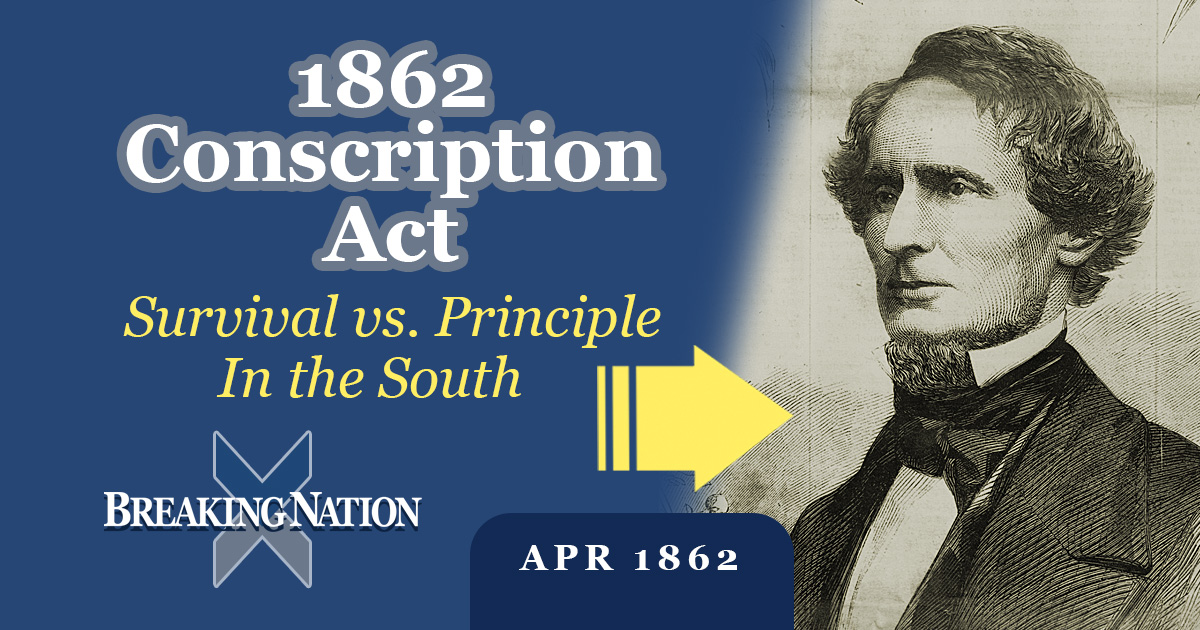
On April 16, 1862, Jefferson Davis approved one of the most consequential—and controversial—laws of the Civil War: the Confederate Conscription Act. Passed by the Confederate Congress, the measure required all white males between the ages of 18 and 35 to serve for three years in the Confederate army. In doing so, it marked the first national conscription law in American history, predating similar Union legislation by nearly a year. Its significance lies not only in its immediate military impact but also in what it revealed about the evolving nature of the Confederacy itself.
At the most basic level, the act was a response to a looming manpower crisis. Early Confederate enthusiasm had produced a surge of volunteers in 1861, but by the spring of 1862—after costly engagements such as Battle of Shiloh—it was clear that voluntary enlistments could not sustain the war effort. Casualties, disease, and expiring one-year enlistments threatened to hollow out Confederate armies just as Union forces were gaining momentum. Conscription provided a blunt but effective solution: it transformed military service from a matter of choice into a legal obligation.
Yet the deeper significance of the law lies in its contradiction of Confederate ideology. The Confederacy had been founded on a strong commitment to states’ rights and a suspicion of centralized authority. By imposing a sweeping national draft, Davis’s government asserted unprecedented federal power over individual citizens and the states themselves. This tension did not go unnoticed. Critics argued that the law resembled the kind of overreach Southerners had long condemned in the Union. In effect, the Confederacy was forced to compromise its founding principles in order to survive.
The act also reshaped Southern society. It placed enormous strain on the home front, as families lost laborers and communities adjusted to the prolonged absence of men. Class tensions deepened, particularly as exemptions—most famously the “twenty-slave law”—allowed certain slaveholders to avoid service. To many poorer whites, conscription came to symbolize a “rich man’s war, poor man’s fight,” eroding unity within the Confederate cause.
Militarily, however, the law helped stabilize Confederate armies at a critical moment. It ensured a steady supply of soldiers and allowed commanders to maintain cohesion in the ranks. While it could not ultimately overcome the Confederacy’s structural disadvantages in manpower and resources, it prolonged the war and enabled continued resistance.
In sum, the April 16, 1862 conscription act was a turning point that exposed the Confederacy’s internal contradictions, intensified social divisions, and underscored the increasing demands of modern, total war.
Breaking Nation: A Civil War Podcast explores the American Civil War, its turning points, and our national memory. Discover full episodes, transcripts, and resources at www.breakingnation.com — your destination for in-depth Civil War podcast content and fresh perspectives on America’s past. Listen on Apple Podcasts, Spotify and Amazon Music.
How the Confederacy Lost Kentucky at Perryville