Jeb Stuart’s Greatest Gamble—and Why It Worked
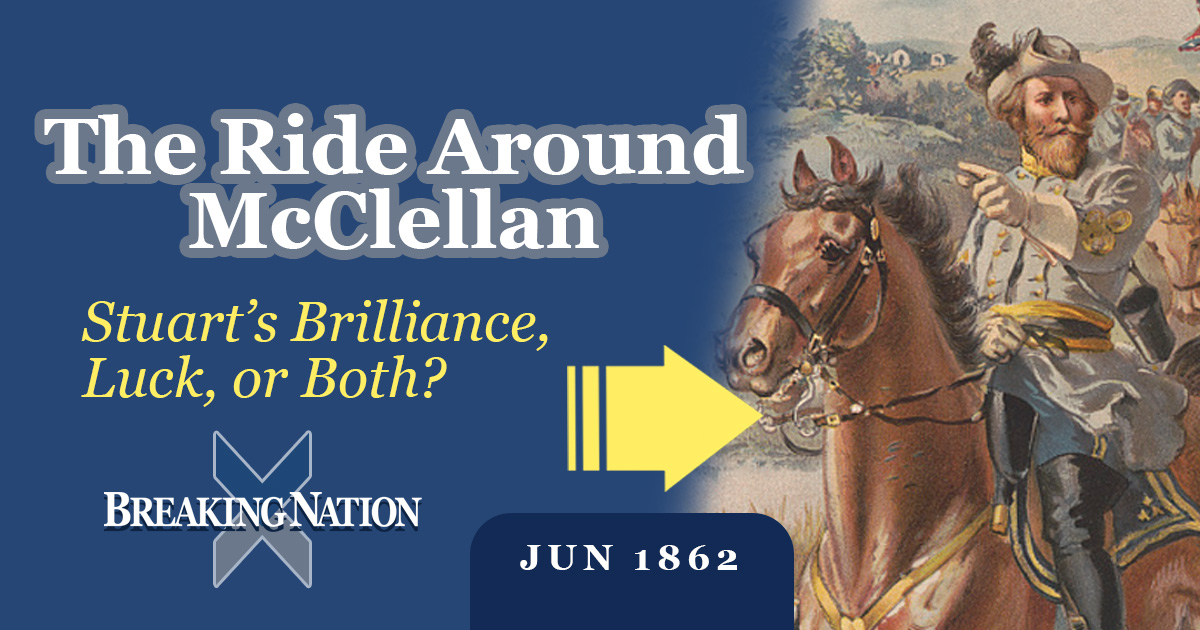
J.E.B. Stuart’s famous ride around Union Major General George B. McClellan’s army from June 12–15, 1862, was one of the most celebrated cavalry operations of the American Civil War. Conducted during the early stages of the Peninsula Campaign, Stuart’s raid was significant not because it changed the military balance of power, but because it provided valuable intelligence, boosted Confederate morale, and exposed weaknesses in Union command and security.
In June 1862, McClellan’s Army of the Potomac was positioned near Richmond, Virginia, threatening the Confederate capital. Confederate General Robert E. Lee, newly appointed commander of the Army of Northern Virginia, needed accurate information about Union positions before launching offensive operations. Stuart volunteered to conduct a reconnaissance mission to determine whether McClellan’s right flank was vulnerable. Accompanied by approximately 1,200 cavalrymen, Stuart crossed the Chickahominy River and discovered that the Union right flank was “in the air,” meaning it lacked strong natural or military protection.
Rather than retrace his route, Stuart made the bold decision to continue riding completely around McClellan’s army. During the three-day operation, his troopers gathered intelligence, destroyed supplies, captured prisoners, and disrupted Union communications. Although the material damage inflicted on the Union army was relatively modest, the psychological impact was enormous. The raid demonstrated that Confederate cavalry could penetrate deep into enemy territory and operate with remarkable freedom.
The ride also had important implications for military leadership. For Lee, Stuart’s intelligence confirmed that McClellan’s forces were divided by the Chickahominy River and vulnerable to attack. This information helped shape Lee’s aggressive strategy during the upcoming Seven Days Battles, which ultimately forced McClellan to retreat from the outskirts of Richmond. While Stuart’s raid alone did not determine the outcome of the campaign, it contributed to Lee’s understanding of the battlefield and reinforced his willingness to seize the initiative.
Equally significant was the embarrassment suffered by the Union high command. McClellan’s inability to prevent Confederate cavalry from circling his army reinforced perceptions that he was overly cautious and lacked effective reconnaissance. Northern newspapers criticized the incident, while Southern newspapers celebrated Stuart as a daring cavalry hero.
In a broader sense, Stuart’s ride highlighted the growing importance of cavalry in the Civil War. No longer limited to traditional scouting duties, cavalry forces increasingly conducted raids, gathered intelligence, and influenced strategic decision-making. Stuart’s successful ride around McClellan became one of the defining cavalry exploits of the war and helped cement his reputation as one of the Confederacy’s most famous military commanders.
Breaking Nation: A Civil War Podcast explores the American Civil War, its turning points, and our national memory. Discover full episodes, transcripts, and resources at www.breakingnation.com — your destination for in-depth Civil War podcast content and fresh perspectives on America’s past. Listen on Apple Podcasts, Spotify and Amazon Music.

Lee Invades the North: The Gamble That Changed the Civil War