Why Lincoln Refused to Fire McClellan When His Own Party Demanded It
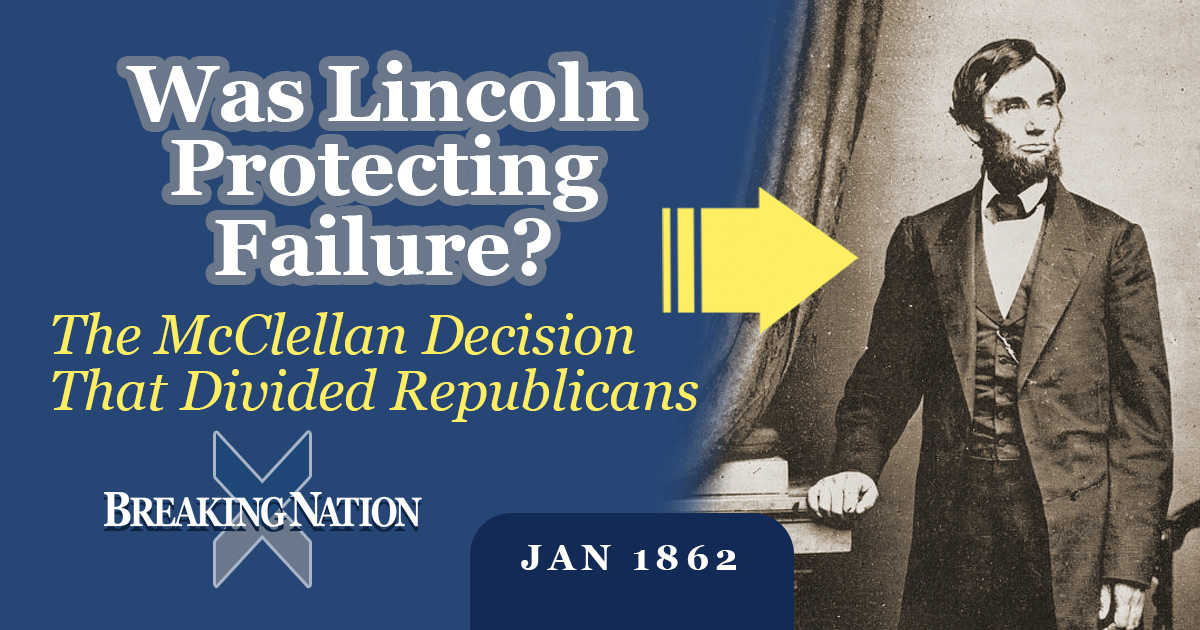
President Abraham Lincoln’s decision on January 6, 1862, to reject a move by Radical Republican senators to force the removal of Major General George B. McClellan was a revealing moment in the political and military balancing act of the Civil War. At a time when Union fortunes appeared stalled and public patience was thinning, Lincoln chose restraint over appeasing the loudest voices in his own party—a choice that underscores his evolving conception of civilian leadership in wartime.
By early 1862, McClellan had become a lightning rod. As commander of the Army of the Potomac, he had built an impressive force but showed a frustrating reluctance to use it. His inflated estimates of Confederate strength and chronic delays infuriated Radical Republicans, who believed the war required aggressive generals and uncompromising policies toward slavery. Senators pressed Lincoln to remove McClellan immediately, arguing that military inertia threatened both the war effort and Republican political fortunes.
Lincoln’s rejection of this pressure was not an endorsement of McClellan’s caution so much as a defense of presidential authority and strategic patience. Lincoln understood that generals could not be changed like cabinet secretaries without consequences. McClellan was enormously popular with his soldiers, and an abrupt removal risked demoralizing the army at a moment when cohesion mattered more than ideological purity. Lincoln also recognized that allowing Congress—particularly a faction within it—to dictate military command would erode civilian control in the wrong direction, substituting legislative interference for executive judgment.
Equally important, Lincoln was still learning how to manage generals. In January 1862, he had not yet found commanders who combined aggressiveness with competence. Removing McClellan without a clear successor might have satisfied Radical anger but worsened military uncertainty. Lincoln’s famous remark that he would “hold McClellan’s horse if he will only bring us success” captures this pragmatism: Lincoln valued results over personalities, even when those personalities tested his patience.
The episode also illuminates Lincoln’s broader political strategy. He was slowly consolidating authority within his party, resisting the Radicals when he believed they moved too fast while also absorbing many of their ideas over time. His later embrace of emancipation makes this point clear. January 1862 was not the moment for open rupture; it was a moment for delay, observation, and leverage.
In retrospect, Lincoln’s decision looks less like weakness than statecraft. He would eventually sideline McClellan after the Peninsula Campaign, but on his own terms and at a time of his choosing. By rejecting the Radicals’ January 6 move, Lincoln affirmed that in a civil war, unity of command—political as well as military—was itself a strategic asset.
Breaking Nation: A Civil War Podcast explores the American Civil War, its turning points, and our national memory. Discover full episodes, transcripts, and resources at www.breakingnation.com — your destination for in-depth Civil War podcast content and fresh perspectives on America’s past. Listen on Apple Podcasts, Spotify and Amazon Music.

The Emancipation Plan You’ve Probably Never Heard Of