When the Confederacy Begged Its Soldiers to Stay
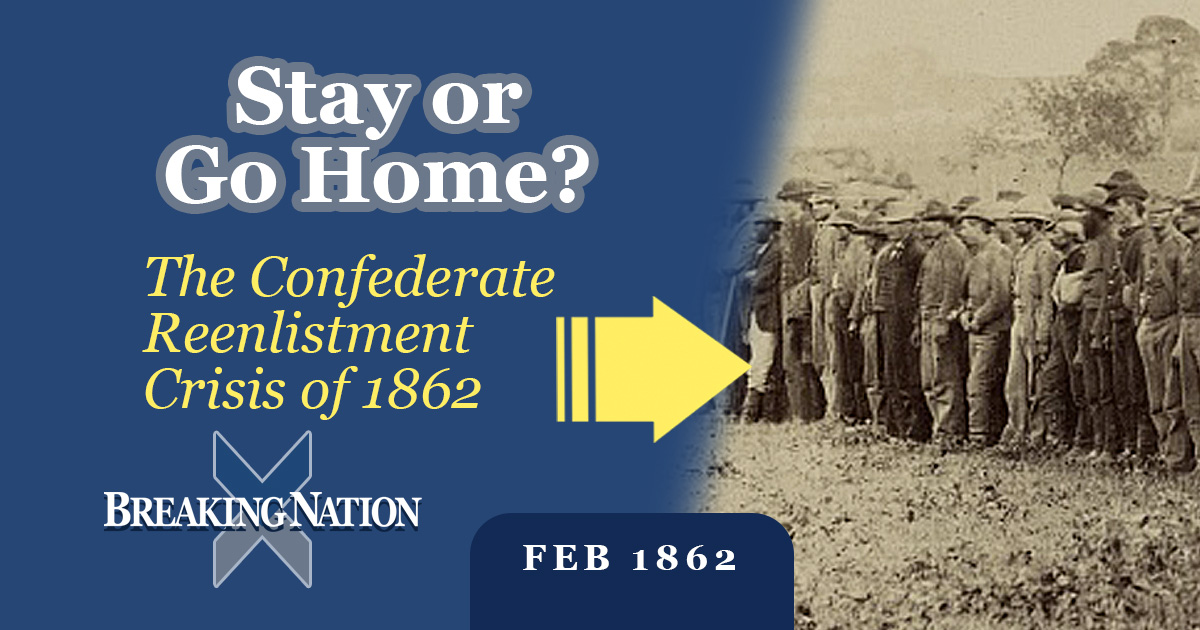
In February 1862, Confederate generals faced a crisis that threatened to unravel their armies just as the war was intensifying. Most Confederate soldiers had enlisted for twelve months in the flush of enthusiasm following secession, confident the conflict would be brief. By early 1862, that confidence was gone. Battlefield realities, mounting casualties, and the sheer scale of the war made clear that independence would not be won quickly. Yet thousands of enlistments were about to expire, forcing Confederate commanders to make direct, emotional appeals to keep their veteran soldiers in the ranks.
These appeals were significant because they revealed how precarious the Confederate war effort already was. Generals understood that losing experienced troops would cripple their armies far more than raw numbers suggested. Training replacements took time the Confederacy did not have, and discipline, cohesion, and battlefield confidence could not be easily replaced. As a result, appeals to reenlist were framed not as bureaucratic requests but as moral imperatives. Soldiers were reminded that the fate of the Confederacy rested squarely on their shoulders.
General P. G. T. Beauregard, addressing troops whose terms were expiring in early 1862, made this explicit. “A victorious army will not abandon its country at such a moment,” he warned, tying continued service directly to national survival. The language was deliberate. By emphasizing victory already achieved and danger still looming, Beauregard sought to shame hesitation while reinforcing the idea that the army and the nation were inseparable. Leaving the ranks was not merely a personal choice; it was a political and moral act with dire consequences.
Other Confederate leaders echoed this theme. In appeals circulated through camps and regiments, soldiers were reminded that history—and their neighbors—were watching. One widely quoted sentiment captured the tone: “The eyes of your countrymen are now upon you, and they expect you to stand firm in this hour of trial.” Such language fused honor, masculinity, and patriotism into a powerful call for reenlistment, reflecting how Confederate leaders understood motivation in a citizen army.
At the same time, these appeals exposed the limits of voluntarism. The very need to persuade troops to stay underscored how fragile the Confederate manpower system was. Appeals could inspire many veterans to reenlist, but they could not guarantee stability. Within weeks, Confederate leaders concluded that persuasion alone was insufficient. The Conscription Act of April 1862 followed directly from this crisis, marking a fundamental shift from a volunteer rebellion to a centralized war state.
The February 1862 appeals thus represent a pivotal moment. They reveal Confederate leaders grappling with the hard truth that ideals and enthusiasm were no substitute for sustained manpower—and that winning independence would demand far more than anyone had imagined in 1861.
Breaking Nation: A Civil War Podcast explores the American Civil War, its turning points, and our national memory. Discover full episodes, transcripts, and resources at www.breakingnation.com — your destination for in-depth Civil War podcast content and fresh perspectives on America’s past. Listen on Apple Podcasts, Spotify and Amazon Music.
A Crisis in Richmond: Why Davis Reorganized His Cabinet