The Emancipation Plan You’ve Probably Never Heard Of
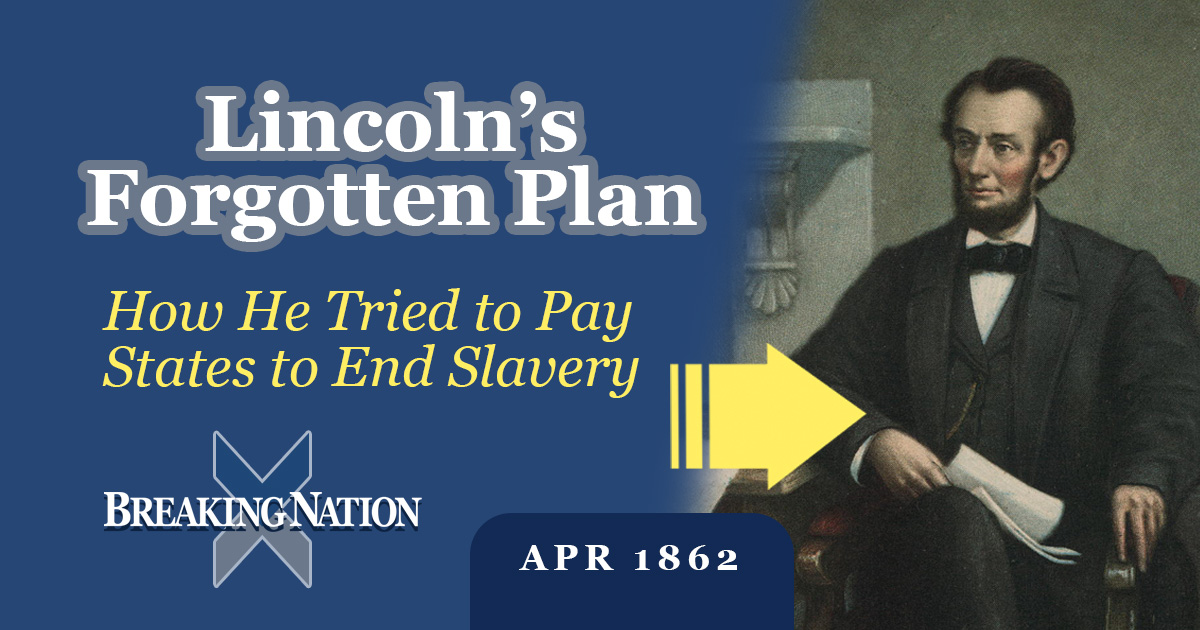
On April 10, 1862, Abraham Lincoln approved Congress’s Joint Resolution offering federal financial aid to any state that chose to adopt gradual emancipation of enslaved people. Though often overshadowed by more dramatic wartime measures, this policy marked a critical transitional moment in the evolution of Union war aims and federal authority over slavery.
At its core, the resolution reflected Lincoln’s pragmatic approach to ending slavery. Rather than immediate, uncompensated emancipation, he proposed a system that would encourage loyal slave states—especially the border states like Kentucky, Missouri, Maryland, and Delaware—to abolish slavery voluntarily, with compensation funded by the federal government. This approach was designed to make emancipation politically palatable to slaveholders while preserving Unionist loyalty in strategically vital regions. In this sense, the resolution was as much a wartime measure as a moral one: weakening the institution of slavery without pushing key states toward the Confederacy.
The significance of the April 10 resolution lies in how it signaled a shift in federal policy. At the war’s outset, Union leaders had been careful to frame the conflict strictly as a struggle to preserve the Union, not to abolish slavery. By early 1862, however, it had become increasingly clear that slavery was inseparable from the Confederacy’s war effort. Enslaved labor sustained Southern agriculture, logistics, and fortifications, making the institution a legitimate military target. Lincoln’s endorsement of compensated emancipation suggested that the federal government was now willing to take active steps toward dismantling slavery, even if cautiously and incrementally.
Equally important, the resolution helped prepare the political and ideological ground for more sweeping measures. Although the border states ultimately rejected the offer, the proposal demonstrated that emancipation had moved from a radical fringe idea to a subject of serious national policy. It also tested public opinion in the North, where attitudes toward slavery were evolving but still divided. By presenting emancipation as orderly, compensated, and state-driven, Lincoln made it easier for moderate Northerners to accept the idea.
In retrospect, the April 10 resolution can be seen as a bridge between early-war conservatism and the revolutionary policies that followed later in 1862, including the Emancipation Proclamation. It revealed Lincoln’s strategic patience: he sought to align moral objectives with political realities, ensuring that when emancipation came on a larger scale, it would be both effective and sustainable. Though the policy itself failed to achieve widespread adoption, its broader significance lies in how it redefined the Union’s trajectory—from merely restoring the nation to fundamentally transforming it.
Breaking Nation: A Civil War Podcast explores the American Civil War, its turning points, and our national memory. Discover full episodes, transcripts, and resources at www.breakingnation.com — your destination for in-depth Civil War podcast content and fresh perspectives on America’s past. Listen on Apple Podcasts, Spotify and Amazon Music.

“Not War as We Knew It”: The Bloody Lesson of Shiloh