The Battle of Kernstown: When Losing Became a Strategic Victory
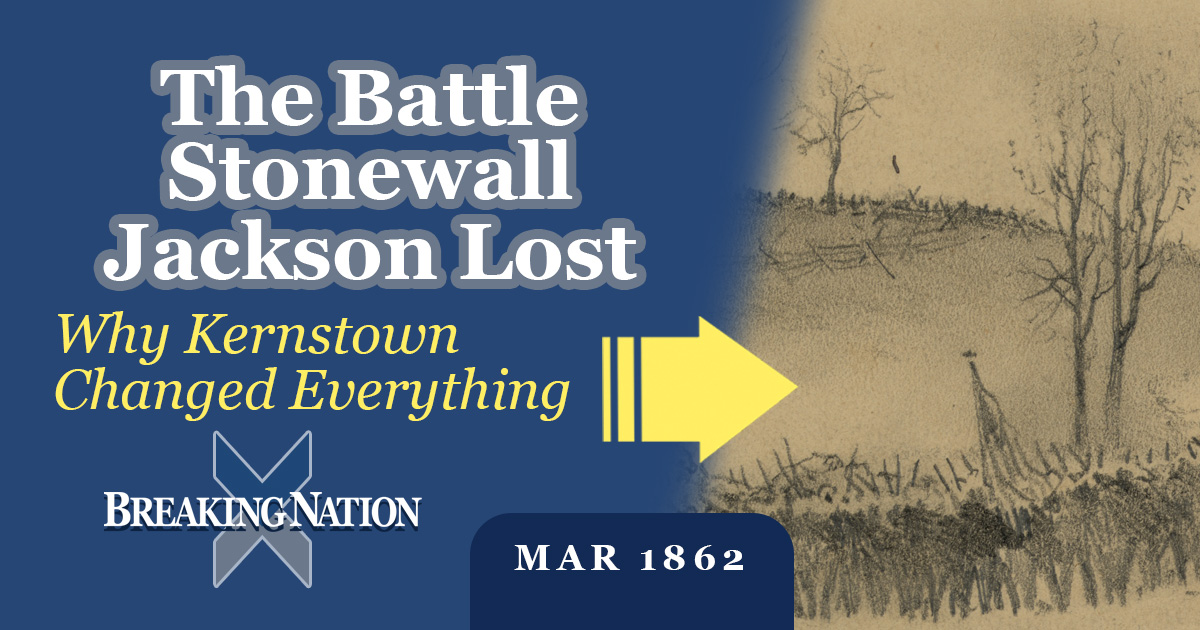
The Battle of Kernstown, fought on March 23, 1862, just south of Winchester in Virginia’s Shenandoah Valley, was a relatively small engagement by Civil War standards. Yet its significance far outweighed the number of soldiers involved. Although Confederate forces under Maj. Gen. Thomas J. “Stonewall” Jackson were tactically defeated by Union troops commanded by Brig. Gen. James Shields, the battle set in motion one of the most famous campaigns of the entire war.
Jackson entered the fight with incomplete information. Confederate cavalry reported that only a small Union rear guard remained near Winchester, as most Federal forces were believed to be withdrawing eastward toward Washington. In reality, Shields had left nearly an entire division behind. Acting on faulty intelligence but eager to strike before the Union army could consolidate, Jackson attacked the Union position near Pritchard’s Hill.
The Confederates initially achieved some success, but as the afternoon wore on the numerical advantage of the Union troops became decisive. A strong Union counterattack eventually forced Jackson’s smaller force to retreat. On paper, Kernstown was a clear Confederate defeat. Jackson lost roughly 700 men, while Union casualties were somewhat lower.
Yet the strategic consequences of the battle were profound. Union leaders in Washington interpreted the Confederate attack as evidence that a substantial Southern force threatened the Shenandoah Valley and, potentially, the approaches to the capital itself. As a result, President Abraham Lincoln and Union high command chose to keep large numbers of Federal troops in the Valley rather than sending them to reinforce Maj. Gen. George B. McClellan’s massive Peninsula Campaign against Richmond.
This decision played directly into Confederate hands. Over the next two months, Jackson launched his brilliant Shenandoah Valley Campaign of 1862, using speed, deception, and aggressive maneuver to defeat several separate Union forces in detail. By tying down tens of thousands of Union troops in the Valley, Jackson prevented them from supporting McClellan’s advance toward the Confederate capital.
Kernstown also had an important psychological impact. Although Jackson rarely admitted mistakes, the defeat reportedly angered him and reinforced his determination to operate with greater secrecy and decisiveness in the weeks that followed. His subsequent victories at places like McDowell, Front Royal, and Winchester would transform him into one of the Confederacy’s most celebrated commanders.
In short, the Battle of Kernstown illustrates a classic paradox of warfare: a tactical defeat that produced strategic success. What looked like a Confederate setback on March 23, 1862 ultimately triggered a chain of events that helped shape the course of the war in Virginia during that critical spring.
Breaking Nation: A Civil War Podcast explores the American Civil War, its turning points, and our national memory. Discover full episodes, transcripts, and resources at www.breakingnation.com — your destination for in-depth Civil War podcast content and fresh perspectives on America’s past. Listen on Apple Podcasts, Spotify and Amazon Music.
Battle of Pea Ridge: The Forgotten Civil War Victory That Secured Missouri for the Union