Lincoln’s War Order No. 3: The Moment That Reshaped Union High Command
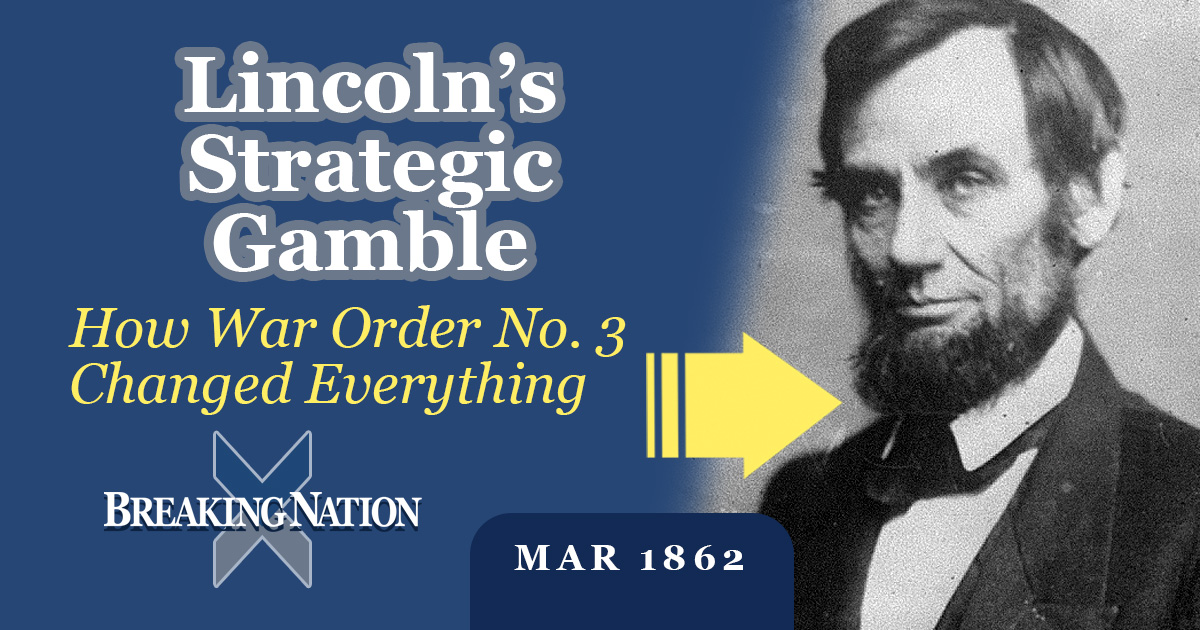
On March 11, 1862, President Abraham Lincoln issued War Order No. 3, a directive that quietly but decisively reshaped Union command during the American Civil War. The order relieved George B. McClellan of his position as general-in-chief of the Union armies, while allowing him to remain in command of the Army of the Potomac. Though the order was brief, its implications were significant for the conduct of the war and for the evolving relationship between civilian leadership and military command.
McClellan had been appointed general-in-chief in November 1861 after the retirement of Winfield Scott. At the time, McClellan enjoyed enormous popularity in the North and was credited with transforming the disorganized Army of the Potomac into a formidable fighting force. However, by early 1862 Lincoln had grown increasingly frustrated with McClellan’s reluctance to launch major offensive operations. McClellan consistently overestimated Confederate strength and argued that he needed more time to prepare before moving against Confederate forces near Richmond, Virginia.
War Order No. 3 represented Lincoln’s solution to this problem. By removing McClellan from the broader role of general-in-chief, Lincoln effectively ended the concentration of strategic authority in one cautious commander. Instead, the president and the War Department began coordinating military operations among several Union armies more directly. This shift marked an important step in Lincoln’s development as a wartime commander-in-chief. Rather than relying entirely on professional soldiers to direct the war, Lincoln increasingly asserted his own strategic oversight.
The order also came at a moment when Union military operations were expanding across multiple theaters. In the West, Union forces under commanders like Ulysses S. Grant had recently captured Fort Henry and Fort Donelson, opening the Tennessee and Cumberland Rivers to Federal control. Meanwhile, McClellan was preparing what would become the Peninsula Campaign against Richmond. Lincoln feared that McClellan could not effectively manage both the Army of the Potomac and the strategic coordination of all Union armies at once—especially given his tendency toward caution.
In practical terms, War Order No. 3 fragmented Union high command. No single officer immediately replaced McClellan as general-in-chief. Instead, several departments operated semi-independently under the supervision of the War Department and Lincoln himself. While this arrangement sometimes produced confusion, it also allowed more aggressive commanders in other theaters to operate with greater initiative.
Ultimately, War Order No. 3 illustrates Lincoln’s growing willingness to intervene in military affairs when he believed the war effort required it. The order signaled the president’s dissatisfaction with delay and his determination to push Union armies into action. Although McClellan would soon begin the Peninsula Campaign, Lincoln’s decision foreshadowed future clashes between the president and his generals over strategy, urgency, and the ultimate direction of the war.
Breaking Nation: A Civil War Podcast explores the American Civil War, its turning points, and our national memory. Discover full episodes, transcripts, and resources at www.breakingnation.com — your destination for in-depth Civil War podcast content and fresh perspectives on America’s past. Listen on Apple Podcasts, Spotify and Amazon Music.
1862 Civil Liberties Clash: Davis, Congress, and Habeas Corpus