How the Battle of Roanoke Island Cracked the Confederate Coast
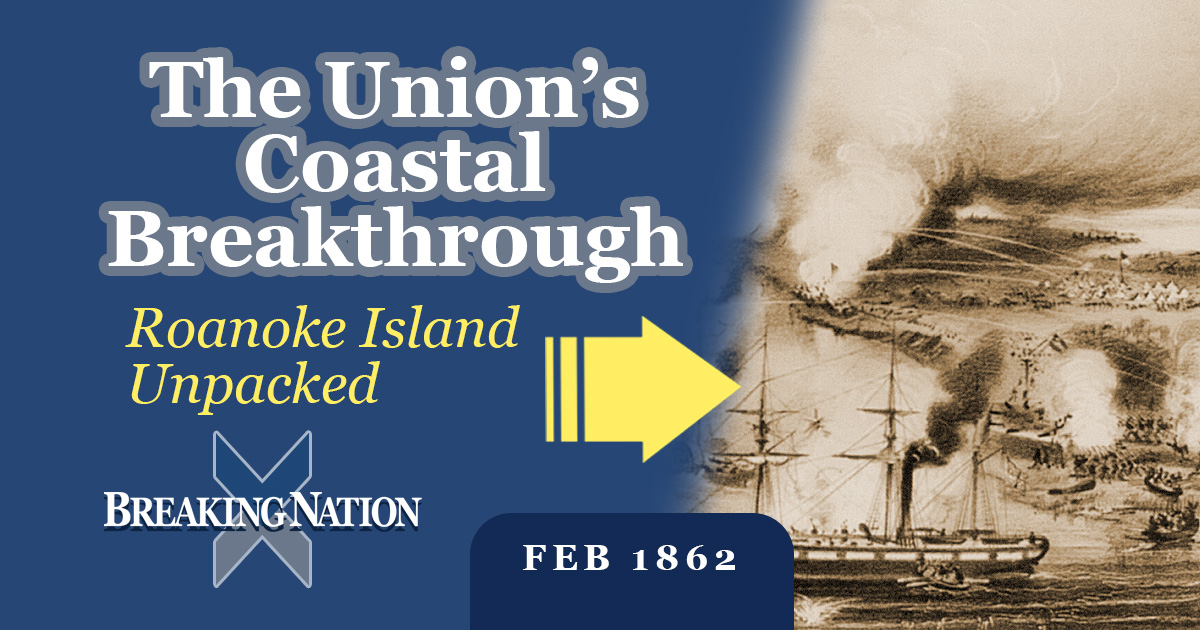
The Battle of Roanoke Island, fought on February 8, 1862, was a small engagement by Civil War standards, but its significance far outweighed its size. Often overshadowed by larger battles unfolding in Virginia and the Western Theater, Roanoke Island marked a turning point in the struggle for control of the North Carolina coast and demonstrated how naval power, joint operations, and geography could shape the course of the war.
Roanoke Island sat at a strategic crossroads of the North Carolina sounds, guarding key waterways that connected the Albemarle and Pamlico Sounds with inland towns and supply routes. For the Confederacy, holding the island meant protecting vital coastal trade and maintaining a buffer against Union incursions into eastern North Carolina. For the Union, capturing it promised something even more valuable: a secure foothold along the Confederate coast and a base for future operations deep into the Southern interior.
The Union assault was part of Ambrose Burnside’s North Carolina Expedition, an early and influential example of coordinated Army–Navy operations. Burnside’s troops, supported by a flotilla of shallow-draft gunboats under Flag Officer Louis M. Goldsborough, overwhelmed a smaller and poorly equipped Confederate force commanded by Brigadier General Henry A. Wise. Confederate defenses were hastily constructed and badly outgunned, and once Union forces landed on the island, resistance collapsed quickly. The result was a clear and decisive Union victory.
The immediate consequences were dramatic. With Roanoke Island in Union hands, Confederate control of northeastern North Carolina unraveled. Elizabeth City fell soon afterward, and Union forces gained access to important inland waterways, threatening rail lines and supply depots. The victory effectively sealed off a large section of the North Carolina coast from Confederate use and curtailed blockade-running operations in the region.
More broadly, Roanoke Island showcased the growing effectiveness of Union amphibious warfare. It reinforced the idea that Confederate coastal defenses—often thin, underfunded, and improvised—were vulnerable to well-planned joint attacks. The battle also boosted Northern morale at a time when clear victories were still relatively rare, coming just days after the fall of Fort Henry in the West.
In the larger narrative of the war, the Battle of Roanoke Island helped shift momentum toward the Union in early 1862. It did not decide the conflict, but it opened doors—strategic, psychological, and operational—that the Union would continue to exploit throughout the war, proving that control of waterways and coastlines could be just as decisive as victories on the battlefield.
Breaking Nation: A Civil War Podcast explores the American Civil War, its turning points, and our national memory. Discover full episodes, transcripts, and resources at www.breakingnation.com — your destination for in-depth Civil War podcast content and fresh perspectives on America’s past. Listen on Apple Podcasts, Spotify and Amazon Music.
The Battle of Kernstown: When Losing Became a Strategic Victory