How Mill Springs Gave the North Hope in the Dark Winter of 1862
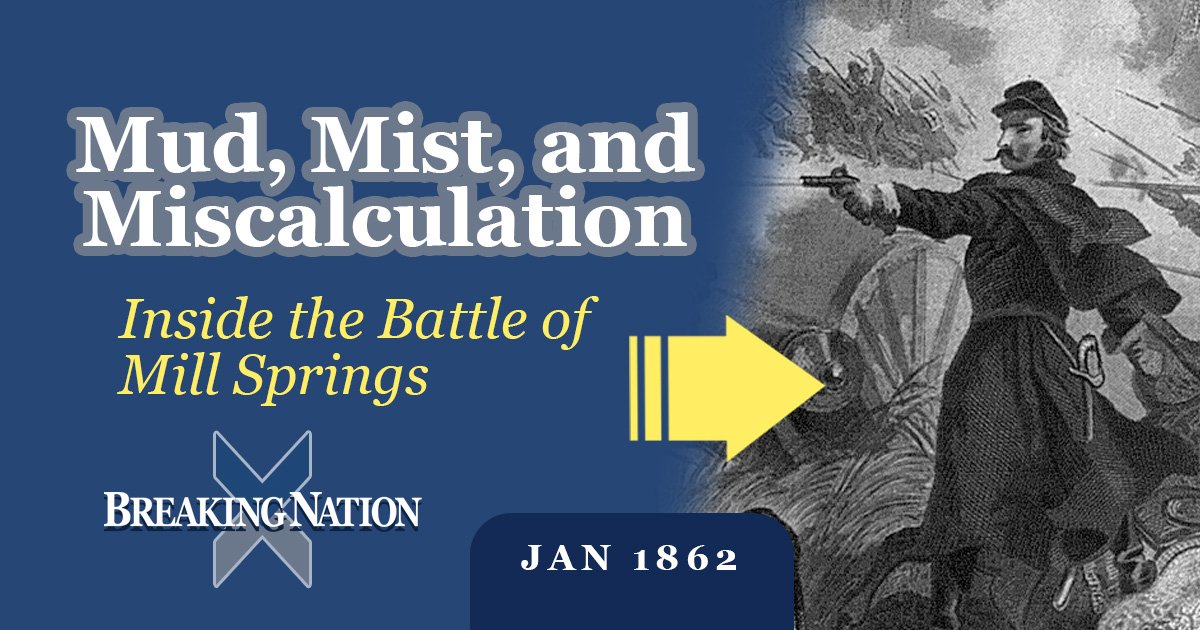
The Battle of Mill Springs, fought on January 19, 1862, occupies a modest place in popular Civil War memory, but its significance—especially at the time—was substantial. Coming in the dark early months of the war, when Union fortunes often seemed bleak, Mill Springs provided the North with a badly needed victory and helped shape the strategic balance in the western theater.
The battle took place in southern Kentucky near Logan’s Crossroads, close to the Cumberland River. Confederate forces under Brigadier General Felix Zollicoffer had crossed the river and taken up an exposed position, a move that worried both his superiors and his men. Union troops, commanded by Brigadier General George H. Thomas, advanced in winter conditions to challenge the Confederate presence. What followed was a confused, rain-soaked fight in which terrain, leadership, and discipline proved decisive.
One of the battle’s most dramatic moments—and one that loomed large in contemporary accounts—was the death of Zollicoffer. Nearsighted and wearing a white raincoat, he reportedly rode into Union lines by mistake and was shot at close range. His death deprived the Confederacy of a politically important general and contributed to the rapid collapse of Southern resistance on the field. By mid-morning, Confederate forces were retreating in disorder back toward the Cumberland River, abandoning artillery, supplies, and wounded.
Strategically, Mill Springs mattered because it helped secure Kentucky for the Union at a critical moment. Kentucky’s loyalty was never guaranteed, and Confederate success there could have threatened Union control of the Ohio River and opened avenues into the Midwest. The Union victory forced Confederate forces out of southeastern Kentucky and disrupted their defensive line in the region, complementing later Union successes at Forts Henry and Donelson.
Just as important was the psychological impact. Mill Springs was one of the first clear-cut Union victories of the war, and it came at a time when Northern morale desperately needed a lift. Newspapers celebrated the triumph, and George H. Thomas emerged as a reliable and steady commander—an early hint of the role he would later play at places like Chickamauga and Nashville.
In short, the Battle of Mill Springs did not decide the war, but it shifted momentum. It demonstrated that Union armies could win in the West, exposed Confederate weaknesses in leadership and positioning, and reassured Northern civilians and politicians that progress was possible. In a conflict where confidence and credibility mattered almost as much as territory, Mill Springs punched well above its weight.
Breaking Nation: A Civil War Podcast explores the American Civil War, its turning points, and our national memory. Discover full episodes, transcripts, and resources at www.breakingnation.com — your destination for in-depth Civil War podcast content and fresh perspectives on America’s past. Listen on Apple Podcasts, Spotify and Amazon Music.
1862 Civil Liberties Clash: Davis, Congress, and Habeas Corpus