Battle of Pea Ridge: The Forgotten Civil War Victory That Secured Missouri for the Union
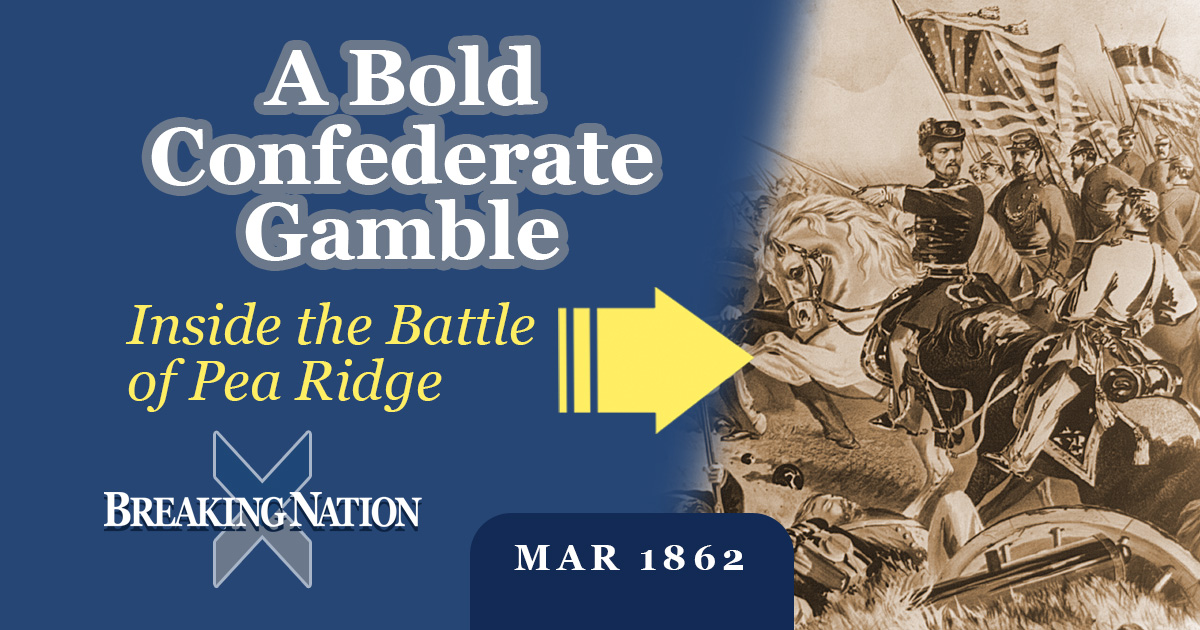
The Battle of Pea Ridge, fought March 7–8, 1862, in northwestern Arkansas, was one of the most consequential yet often overlooked engagements of the early Civil War. Though it occurred far from the war’s eastern headlines, the battle decisively shaped the strategic balance in the Trans-Mississippi and secured Union control of Missouri for the remainder of the conflict.
The battle emerged from a Confederate effort to reclaim Missouri, a deeply contested border state whose loyalty had enormous political and military importance. In early 1862, Confederate Major General Earl Van Dorn assembled an ambitious army of roughly 16,000 men drawn from Arkansas, Texas, Louisiana, and the Missouri State Guard under Sterling Price. Van Dorn hoped to surprise and defeat the Union Army of the Southwest, commanded by Brigadier General Samuel R. Curtis, which had advanced into Arkansas after pushing Confederate forces out of Missouri earlier in the winter.
Van Dorn attempted a bold maneuver. Rather than attack the Union army directly, he marched his forces around Curtis’s right flank and attempted to strike the Federals from the rear along Pea Ridge. Initially the movement achieved tactical surprise, but the plan quickly unraveled. Confederate troops were exhausted from long marches, command coordination faltered, and key leaders—including General Ben McCulloch and Brigadier General James McIntosh—were killed early in the fighting. Their deaths caused confusion within the Confederate right wing and deprived Van Dorn of experienced leadership at a critical moment.
Curtis, meanwhile, responded with calm flexibility. Union forces rapidly reoriented their lines to face the unexpected threat from the north. On the second day of the battle, Federal artillery and infantry assaults concentrated against the Confederate center near Elkhorn Tavern. With ammunition running low and his army disorganized, Van Dorn ordered a retreat. By the afternoon of March 8, the Confederate offensive had collapsed.
The significance of Pea Ridge lies primarily in its strategic consequences. The Union victory effectively ended large-scale Confederate hopes of regaining Missouri. From that point forward, Missouri remained firmly under Union control, allowing the state to serve as a base for Federal operations deeper into Arkansas and the Indian Territory. The battle also demonstrated the growing organizational strength of Union armies in the West, which were beginning to combine mobility, logistics, and artillery in ways that Confederate commanders struggled to counter.
Pea Ridge further highlighted the multinational and diverse character of the Trans-Mississippi war. Both sides included large numbers of German-American soldiers, and the Confederate army even fielded several regiments of Native American troops under leaders such as Albert Pike.
Although overshadowed by better-known battles in Tennessee and Virginia, Pea Ridge was a decisive moment in the western theater. By securing Missouri and stabilizing Union control along the northern edge of Arkansas, the battle helped shape the strategic map of the Civil War for the remainder of the conflict.
Breaking Nation: A Civil War Podcast explores the American Civil War, its turning points, and our national memory. Discover full episodes, transcripts, and resources at www.breakingnation.com — your destination for in-depth Civil War podcast content and fresh perspectives on America’s past. Listen on Apple Podcasts, Spotify and Amazon Music.
1862 Civil Liberties Clash: Davis, Congress, and Habeas Corpus