1862 Civil Liberties Clash: Davis, Congress, and Habeas Corpus
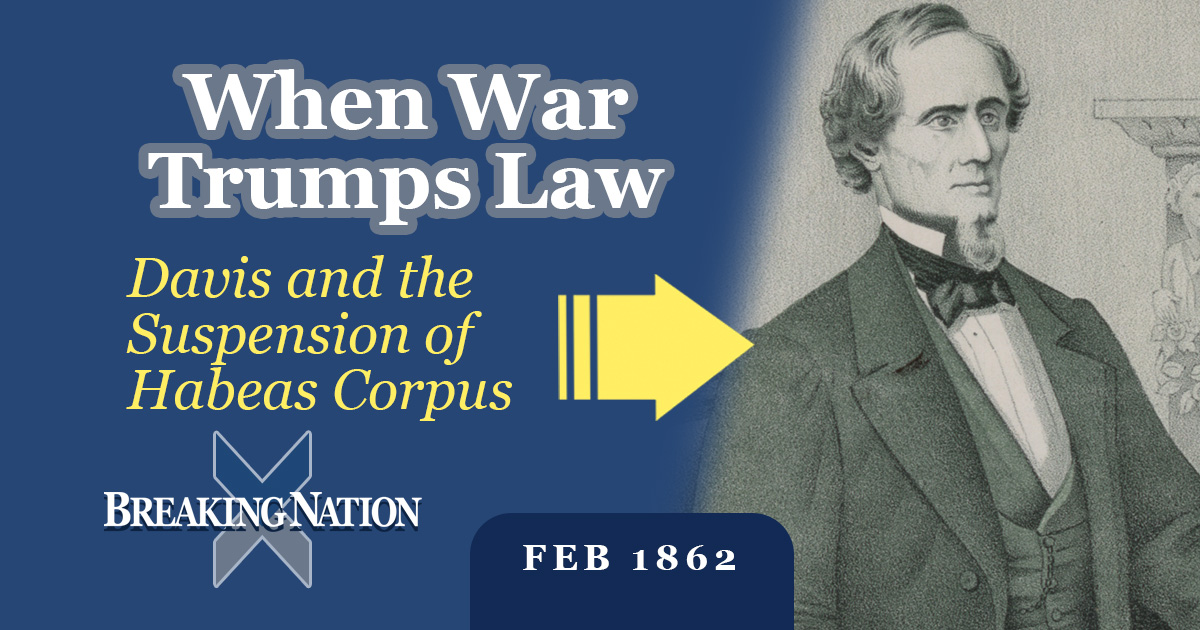
On February 27, 1862, the Confederate Congress granted President Jefferson Davis the authority to suspend the writ of habeas corpus—a move that spoke volumes about how desperate, centralized, and strained the Confederate war effort had already become less than a year into the Civil War. Though the Confederacy was founded on the principles of limited government and states’ rights, this decision revealed how quickly ideological commitments bent under the pressures of total war.
Habeas corpus, the legal safeguard that protects individuals from arbitrary arrest and detention, was deeply rooted in Anglo-American legal tradition. Suspending it was no small matter. By empowering Davis to authorize military arrests without immediate judicial review, Congress effectively acknowledged that the Confederacy faced serious internal threats—real or perceived—that could not be managed through normal civil processes. These threats included desertion, draft resistance, Unionist activity (especially in border regions and Appalachia), and political dissent at home.
The timing of the act is critical. Early 1862 was a moment of crisis for the Confederacy. Union victories at Forts Henry and Donelson had cracked open the Western Theater, Nashville was about to fall, and Confederate morale was uneven. Manpower shortages were becoming acute, prompting the first discussions of conscription. In this context, internal unity became a strategic necessity. Granting Davis extraordinary powers was less about abstract constitutional theory and more about keeping the Confederate war machine from unraveling.
Yet the decision was deeply ironic. Southern leaders had justified secession by accusing the federal government of tyranny and executive overreach. Now, Confederate lawmakers were granting their own president powers that many white Southerners had long feared. Davis himself was no casual authoritarian; he viewed suspension of habeas corpus as an emergency measure, not a permanent policy. Still, the act marked a decisive shift toward wartime centralization and executive dominance.
The February 27 legislation also highlighted the uneasy relationship between civilian liberty and military necessity. Confederate courts, governors, and newspapers would continue to debate—and often resist—Davis’s use of these powers throughout the war. States’ rights advocates bristled at military arrests and the erosion of local authority, foreshadowing internal conflicts that would plague the Confederacy until its collapse.
In the end, the suspension of habeas corpus underscored a central truth of the Confederate experiment: survival required compromises that cut against its founding ideals. The measure did not save the Confederacy, but it revealed how profoundly the demands of modern war reshaped Southern politics, governance, and civil liberties in real time.
Breaking Nation: A Civil War Podcast explores the American Civil War, its turning points, and our national memory. Discover full episodes, transcripts, and resources at www.breakingnation.com — your destination for in-depth Civil War podcast content and fresh perspectives on America’s past. Listen on Apple Podcasts, Spotify and Amazon Music.

The Emancipation Plan You’ve Probably Never Heard Of